
Event Cleaning Services in Hyde Park Chicago
Hyde Park Event Cleaning for Griffin Museum of Science and Industry, Rockefeller Chapel, University of Chicago Campus Events, Jackson Park, 57th Street Art Fair, Chosen Few Festival, and Neighborhood Venue Events
Event Cleaning Chicago provides post-event cleaning services in Hyde Park for university event coordinators, museum rental managers, nonprofit development staff, campus conference organizers, outdoor festival producers, academic gala directors, and private venue operators who need same-night floor recovery, academic-venue handback, exhibit-adjacent surface remediation, outdoor park footprint clearing, restroom reset, and documented site restoration before morning inspections.
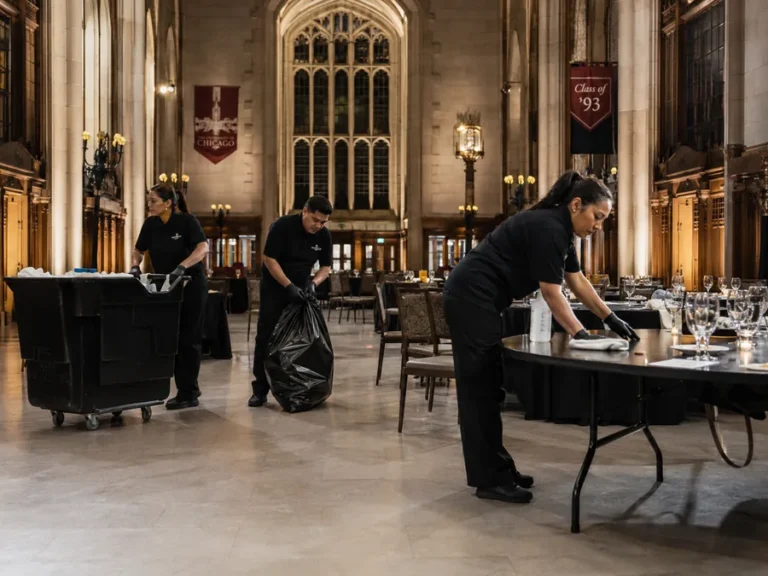
⭐⭐⭐⭐⭐ 5.0 Rating | 100+ Chicago Events Cleaned | AAM-Aligned Museum Cleaning Awareness | OSHA-Aligned Chemical Safety SOPs | IICRC S210 Stone Surface Protocol Informed | Bonded & Fully Insured | University and Museum Venue Cleaning | Jackson Park and Midway Plaisance Outdoor Events
"The Lecture Ended. The Gala Wrapped. 1,200 Guests Just Walked Through a 130-Year-Old Building — and the University Expects It Back Clean by 7 AM."
That is the specific pressure of a Hyde Park event.
Hyde Park is not simply a Chicago neighborhood. According to Wikipedia, it is a 1.65-square-mile community area on Chicago’s South Side, roughly seven miles south of the Loop, bounded by East 51st Street to the north, the Midway Plaisance to the south, Washington Park to the west, and Lake Michigan to the east. It was founded in 1853 by real estate developer Paul Cornell and became part of Chicago in 1889. (Wikipedia: Hyde Park, Chicago) Today it is home to the University of Chicago — founded in 1890 with funding from John D. Rockefeller — and to the Griffin Museum of Science and Industry, the largest science museum in the Western Hemisphere, housed in the only surviving structure from the 1893 World’s Columbian Exposition. (Wikipedia: Museum of Science and Industry, Chicago)
That institutional density is what makes Hyde Park’s event cleaning problem fundamentally different from any other Chicago neighborhood. When an event organizer books a Hyde Park venue, they are not booking a converted warehouse or a modern banquet hall. They are likely booking a limestone-faced Gothic Revival building constructed between 1890 and 1940, a Beaux-Arts museum rotunda with a 120-foot copper-domed ceiling, or a park that has been on the National Register of Historic Places since 1972. (Chicago Hyde Park Historical Society)
The real cleaning challenge in Hyde Park is not just volume — it is material sensitivity combined with institutional accountability.
Research published by the American Alliance of Museums (AAM) makes this explicit: cleaning methods appropriate for standard commercial facilities can cause direct damage to cultural property in historic institutional spaces. The AAM’s “Cleaning the Museum Without Damage” framework notes that dirt tracked in from outdoors — specifically grit and particulate — damages wooden floors and historic floor coverings through abrasion, and that standard household or commercial cleaning products have the potential to cause irreversible harm to surfaces in museum, historic, and archive settings when applied without surface-specific protocols. (AAM, C2C Care Course: Cleaning the Museum Without Damage) This is not a theoretical risk in Hyde Park.
It is a practical reality in every post-event cleanup that touches the Griffin MSI’s exhibit-area floors, Rockefeller Chapel’s stone nave, the Oriental Institute’s gallery corridors, or UChicago’s Gothic quadrangle buildings.
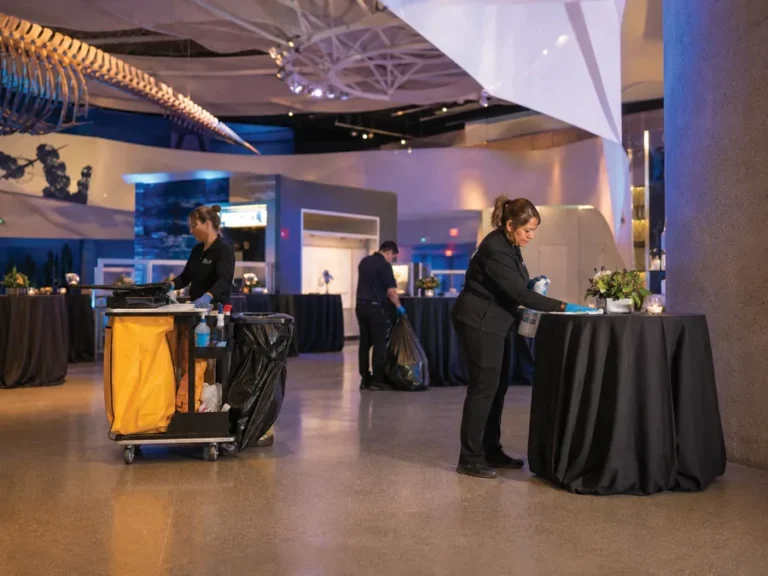
Outdoor Hyde Park events add a second compliance layer. Jackson Park — a 552-acre National Register of Historic Places park designed in the aftermath of the 1893 World’s Fair — hosts events including the Chosen Few Picnic and Festival (approximately 40,000 to 45,000 attendees), the Hyde Park Jazz Festival (20,000 music lovers across 13 venues), and the 57th Street Art Fair (the Midwest’s oldest outdoor juried art fair, running since 1948 with 200+ exhibitors). Outdoor events on Chicago Park District property at this scale are governed by the DCASE Special Event Permit framework, which requires insurance certificates with minimum $1,000,000 in commercial general liability for street closures, site plans, and documented site restoration as conditions of permit issuance. (DCASE Special Events Resource Guide, 2025) The University of Chicago’s own outdoor event policy additionally requires written advance approval for temporary structures — tents, stages, fencing, barriers — and consultation with its Environmental Health and Safety Office for any such installations on campus property. (UChicago Student Manual: Outdoor Events on Campus)
The University of Illinois Chicago’s Zero Waste Events program, applied broadly across Chicago’s institutional event sector, defines the operational framework many campus and museum events increasingly follow: waste diversion through source separation, organic composting streams, and documented recycling — all of which require structured waste management during the cleanup, not a single trash sweep at the end. (UIC Sustainability: Zero Waste Events)
What all of this means in practice: a Hyde Park event cleanup covers limestone nave floors with 90 years of foot-traffic history, exhibit-adjacent hard floors where cleaning chemistry must be cleared by venue staff, outdoor park grounds that require documented restoration, and academic venues with early-morning building access deadlines enforced by university facilities operations.
The sections below cover exactly what that cleanup looks like — venue by venue, surface by surface, zone by zone — and why standard post-event cleaning crews fail in Hyde Park before they even read the surface type.
Hyde Park's Venue Map — What an Event Organizer Is Actually Managing
Hyde Park’s event footprint includes five distinct venue categories. Treating them with a single cleaning approach is the most expensive mistake an organizer can make.
Griffin Museum of Science and Industry (5700 S. DuSable Lake Shore Dr.)
Rockefeller Memorial Chapel (5850 S. Woodlawn Ave.)
University of Chicago Campus Venues (Ida Noyes Hall, Quadrangle Club, Smart Museum of Art, Oriental Institute)
Jackson Park and Midway Plaisance Outdoor Events
Neighborhood Commercial Venues (Harper Court, 53rd Street Corridor, Chicago Theological Seminary)
The Risks No One Briefs You On Until the Building Manager Calls
Exhibit-Adjacent Floor Chemistry Failure
Stone Surface Etching in Gothic Campus Buildings
Jackson Park Osaka Garden Proximity
University Campus Facilities Deadlines
Multi-Surface Complexity Inside a Single Building
How We Clean a Hyde Park Event — Institutional Protocol, Not Generic Cleanup
Venue Classification and Surface Pre-Confirmation
Exhibit-Adjacent Zones — Containment and Chemistry Control
Stone Surface Sequence — Calcium-Safe Chemistry
Outdoor Park Zone — Waste Priority and Restoration Documentation
Restroom Recovery and High-Touch Disinfection
Waste Diversion and Stream Separation
Documentation and Handback
Why Hyde Park Event Organizers Call Us Instead of a Standard Post-Event Crew
We Understand AAM-Aligned Museum Cleaning Standards
IICRC S210 Stone Protocol Is Built Into Our Process
Jackson Park and Midway Plaisance Restoration Is Documented
University Facilities Deadlines Are Non-Negotiable
Waste Diversion Is Built In for Campus and Sustainability Events
Outdoor Festival Scale Does Not Phase Us
OSHA-Aligned Chemical Handling Throughout
Hyde Park Event Cleaning Case Studies
Case Study 1: Griffin Museum of Science and Industry — Corporate Gala, Rotunda and West Pavilion
Client type: Corporate event director
Guest count: 850
Venue footprint: Rotunda (5,500 sq ft standing capacity zone used at 850 guests) + West Pavilion Main Floor and Balcony (850 combined capacity) + outdoor portico
Event type: Corporate gala with dinner stations, open bar, and exhibit-area cocktail reception
Timeline: 4.5-hour cleanup window, 7 AM venue facilities walkthrough
The problem: The event used food and beverage stations positioned throughout exhibit-adjacent zones in both the Rotunda and West Pavilion. By event close, 850 guests had generated drink spills, food debris, and tracked-in particulate across two exhibit-area floors with different surface types. The outdoor portico had beverage cups and napkins scattered across approximately 3,200 sq ft of stone and paved surface. The venue required vendor compliance documentation per Griffin MSI’s Chicago Park District insurance mandate.
What we did: Surface classification confirmed Rotunda floor as polished institutional stone and West Pavilion as sealed hard floor — separate chemistry protocols for each. Exhibit-adjacent zone protocol: dry particulate removal first on all zones before any liquid application. pH-neutral chemistry used on all polished stone surfaces. No acidic or alkaline products in exhibit-adjacent areas. Outdoor portico cleared first (organic waste containment before surface cleaning). Restrooms documented in parallel. Vendor compliance documentation with zone photographs produced before 6:45 AM.
Outcome: Griffin MSI facilities walkthrough completed without surface damage findings. Vendor compliance documentation submitted without dispute.
Client name withheld for confidentiality.
Case Study 2: Rockefeller Chapel — University Convocation Reception
Client type: University events office
Guest count: 620
Venue footprint: Main chapel nave (1,500 seating capacity zone used at 620) + antechamber + exterior campus plaza
Event type: Post-convocation reception with catering and bar service
Timeline: 3-hour cleanup window, 8 AM campus facilities inspection
The problem: Post-convocation receptions at Rockefeller Chapel combine stone nave floor traffic with catering positioned in the antechamber and exterior campus plaza. With 620 guests moving between zones, the stone floor accumulated tracked-in grit from the exterior plaza, food debris from the catering area, and beverage spills near the original carved stone wall bases. The campus facilities inspector required before/after photo documentation of the nave floor and antechamber.
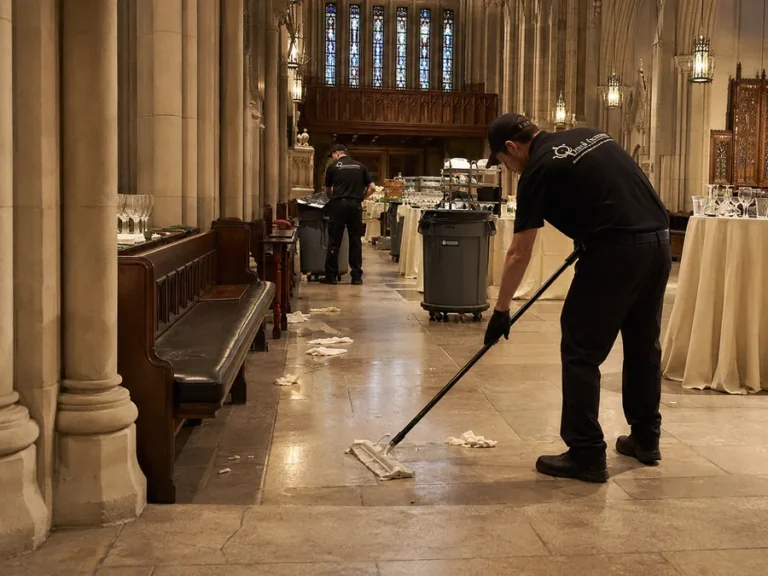
What we did: Stone surface protocol: grit and particulate removal first across the full nave floor using soft-bristle equipment before any liquid application. pH-neutral stone-safe cleaning solution applied with controlled moisture — no mops with standing water, which can wick into stone floor grout and cause calcium carbonate migration. Antechamber catering zone cleared and treated with separate chemistry confirmation. Exterior plaza swept and photographed. Before/after photo documentation of nave floor and antechamber completed for campus facilities record.
Outcome: Campus facilities inspection passed without surface findings. Stone floor showed no new etching or staining damage from post-event chemistry. Documentation submitted to university events office before 7:55 AM.
Client name withheld for confidentiality.
Case Study 3: Jackson Park — Post-Festival Outdoor Cleanup, Chosen Few Adjacent Zone
Client type: Community event coordinator
Footprint: Approximately 4.5 acres in Jackson Park along South Stony Island Avenue corridor
Event type: Large-scale outdoor music and community festival
Timeline: Same-night cleanup, Chicago Park District restoration documentation required
The problem: A major outdoor festival in Jackson Park left food vendor residue, beverage waste, and general debris across 4.5 acres of park lawn, pathways, and asphalt-edged zones. The western edge of the cleanup zone ran adjacent to the Osaka Garden’s landscape boundary — within approximately 60 feet of protected plantings. Organic waste (food containers, grease-soaked packaging, open beverage vessels) left near this boundary presented a park restoration compliance risk. The event coordinator required Chicago Park District site restoration documentation.
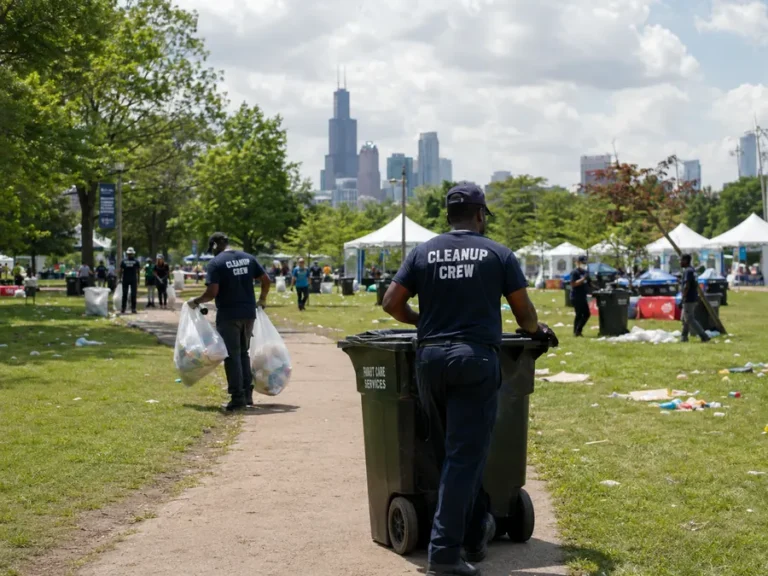
What we did: Osaka Garden perimeter treated as first-priority collection zone: all organic waste within 80 feet of the garden boundary collected and containerized before the main footprint sweep began. Lawn divided into 6 sections with 2-person teams per section working parallel paths. Food vendor zones: organic waste collected and sealed, asphalt grease spots treated with appropriate asphalt-safe degreaser (no chemical runoff into adjacent lawn or drainage zones). Waste separated into organics, recyclables, and general streams. Section-by-section photographs produced covering all 4.5 acres. Handback documentation submitted to event coordinator with restoration confirmation for Park District file.
Outcome: Chicago Park District permit restoration requirement met. No post-event compliance notice issued. Event coordinator confirmed permit documentation accepted without dispute.
Client name withheld for confidentiality.
Testimonials
“Griffin MSI requires vendor compliance documentation and exhibit-adjacent surface protocols. Abdullah’s team understood the restrictions before they arrived, cleared every zone correctly, and had documentation ready before the 7 AM facilities walkthrough.”
Corporate Event Director | Griffin Museum of Science and Industry, Hyde Park
“Rockefeller Chapel’s stone floor cannot be cleaned with standard products. We needed pH-safe chemistry, grit removal first, and before/after documentation for the campus inspector. They delivered all three before 8 AM.”
University Events Coordinator | Rockefeller Chapel, University of Chicago
“The festival footprint ran close to the Osaka Garden boundary. Abdullah’s crew treated that perimeter first, worked in parallel sections, separated the waste streams, and gave me the Park District documentation I needed. No complaints, no issues.”
Community Event Coordinator | Jackson Park, Hyde Park
Hyde Park Event Cleaning Pricing
Pricing depends on surface type, exhibit-adjacent restrictions, venue access requirements, guest count, food and beverage volume, outdoor footprint, protected landscape proximity, Park District documentation requirements, waste separation scope, and handback deadline.
Museum and Exhibit-Adjacent Venue Cleanup (polished stone, institutional floor) — up to 5,000 sq ft
Gothic Campus or Chapel Venue Cleanup (limestone, carved stone, mixed hard floor)
Combined Indoor Museum + Outdoor Plaza Event Cleanup
Jackson Park / Midway Plaisance Outdoor Festival Cleanup — per acre zone
Full Buyout Museum Event or Multi-Venue University Gala
Ongoing University Event Season Contract (academic year, alumni weekends, recurring galas)
FAQs About Event Cleaning Services in Hyde Park Chicago
Hyde Park Events Happen Inside History. The Cleanup Has to Respect That.
A 120-foot copper dome. A Gothic chapel built from 32,000 tons of cut stone. A park on the National Register of Historic Places. A museum that is the only surviving building from a 19th-century World’s Fair.
These are not typical Chicago venue cleanup scenarios. They require surface knowledge, the right chemistry, structured zone protocols, and documentation that satisfies university facilities, museum operations, and Chicago Park District permit compliance simultaneously.
Call before the event ends — not after the building manager discovers what the wrong cleaning product did to a century-old stone floor.
✅ Griffin MSI exhibit-adjacent surface and Rotunda cleanup
✅ Rockefeller Chapel limestone and Gothic campus stone protocol
✅ University of Chicago campus event and outdoor quad cleanup
✅ Jackson Park and Midway Plaisance outdoor festival clearing
✅ AAM-informed museum cleaning chemistry protocols
✅ Chicago Park District site restoration documentation
✅ Waste stream separation for campus sustainability events
✅ OSHA-aligned chemical safety SOPs throughout