Event Cleaning Services in Bridgeport Chicago
Bridgeport Event Cleaning for Bridgeport Art Center Skyline Loft and Sculpture Garden, Zhou B Art Center, Rate Field Suite and Stadium Events, 35th Street Corridor Venues, and Neighborhood Industrial Loft Event Spaces
Event Cleaning Chicago provides post-event cleaning services in Bridgeport for industrial loft venue managers, art center event coordinators, stadium hospitality staff, corporate event directors, gallery reception managers, and private venue operators who need same-night hardwood and reclaimed-surface floor remediation, reclaimed granite brick outdoor zone clearing, art-adjacent gallery cleaning protocol, stadium suite and concourse reset, catering zone cleanup, and documented venue handback before morning building operations resume.
⭐⭐⭐⭐⭐ 5.0 Rating | 100+ Chicago Events Cleaned | OSHA-Aligned Chemical Safety SOPs | AAM-Aligned Gallery Cleaning Awareness | Bonded & Fully Insured | Industrial Warehouse Loft, Stadium Suite, and Art Gallery Venue Cleaning | Available Game Nights and Concert Nights
"The Wedding Ended in an 18,000-Square-Foot Timber Loft on the Fifth Floor of a 1911 Warehouse. The Gala Finished in a Reclaimed Granite Brick Sculpture Garden. And the Suite Party Wrapped at Rate Field After the Final Out. Three Buildings, Three Completely Different Surface Problems — All Happening on the Same Block of West 35th Street."
That is Bridgeport’s event cleaning reality.
Bridgeport, Chicago is Community Area 60 on the city’s South Side — a 2.10-square-mile neighborhood approximately three miles southwest of the Loop, bounded by the South Branch of the Chicago River to the north, Ashland Avenue to the west, Pershing Road to the south, and the Union Pacific Railroad tracks to the east. (Wikipedia: Bridgeport, Chicago) With a 2023 population of 33,091 and a demographic composition that is 40.7% Asian and 22.5% Hispanic — alongside its historically Irish and Polish working-class roots — Bridgeport is one of Chicago’s most demographically layered neighborhoods. (Wikidata: Bridgeport, Chicago)
Bridgeport’s identity is shaped by two parallel histories that directly determine its event cleaning landscape. The first is industrial: Irish immigrants arrived in 1836 to dig the Illinois and Michigan Canal, establishing Bridgeport as Chicago’s first industrial neighborhood. The Central Manufacturing District — described as the United States’ first planned industrial district, covering 265 acres across Bridgeport and McKinley Park — drew meat-packing, rail, and manufacturing industry to the neighborhood’s 35th Street corridor through the late 19th and early 20th centuries. (Wikipedia: Central Manufacturing District) The massive warehouse buildings constructed in this era — including the Albert Pick & Co. warehouse at 1200 W. 35th Street, designed by noted architect A.S. Alschuler in the Classical Revival style, built in 1911 and later expanded in 1922 and 1928 before Spiegel Catalog occupied it until 1978 — are now Bridgeport’s primary event venues. (Bridgeport Art Center: History)
The second history is political: Bridgeport produced five Chicago mayors, most notably Richard J. Daley, who served from 1955 until his death in 1976 — described by historian Michael Beschloss as the “pre-eminent mayor of the 20th century.” (WTTW Chicago: Bridgeport) That political legacy reinforces what WTTW describes as Bridgeport’s current identity: a neighborhood that now functions as “a mecca for artists to open studios in all mediums,” with growing restaurant density and an arts-and-event infrastructure anchored by the repurposed industrial buildings along 35th Street.
The defining challenge of Bridgeport event cleaning is the material heterogeneity of 1911 industrial construction combined with active gallery use — and the surface sensitivity of reclaimed and original materials that have not been replaced in over a century.
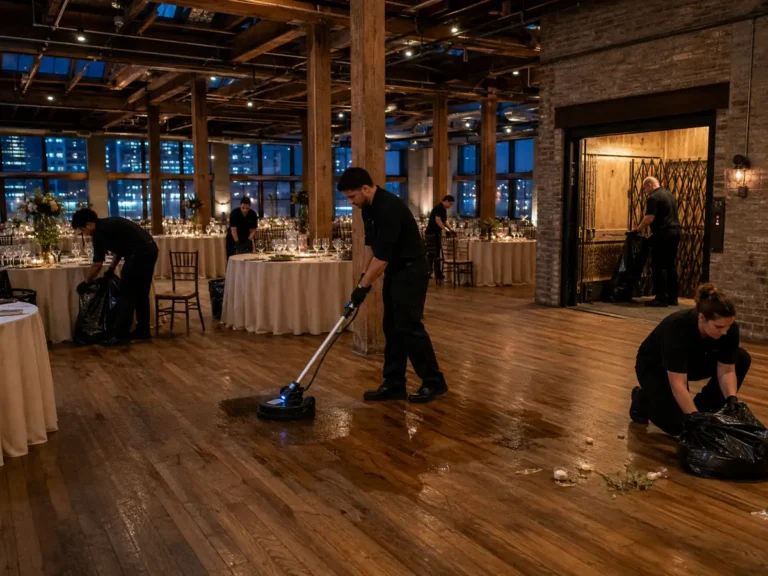
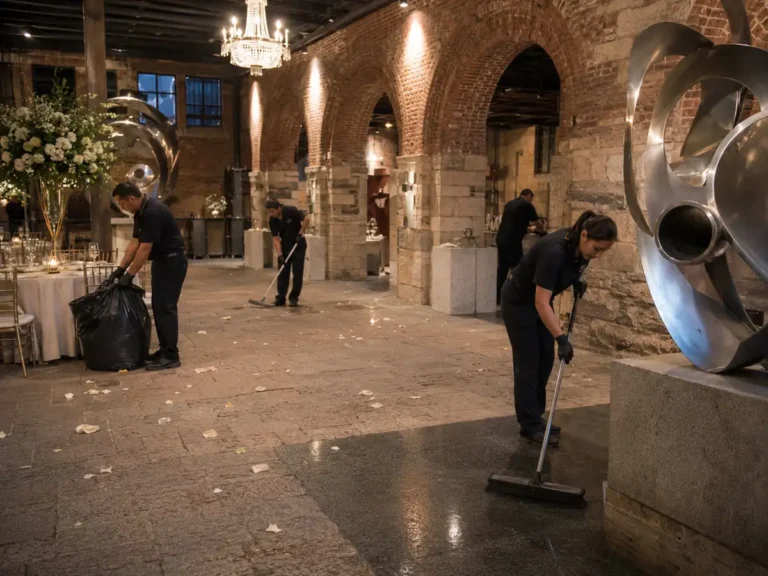
The Bridgeport Art Center at 1200 W. 35th Street is housed in the former Albert Pick & Co. warehouse — a 500,000-square-foot Classical Revival industrial building now holding three curated art galleries, artist studios, a Fashion Design Center, a Chicago Ceramic Center, and two event venues. (Bridgeport Art Center: Venues) The Skyline Loft on the fifth floor spans 18,000 square feet with original timber beams, hardwood floors, enormous skylights, and a vintage freight elevator that arrives with a chandelier. The Sculpture Garden Gallery on the ground floor occupies 12,000 square feet of indoor space plus 3,000–4,500 square feet of covered outdoor space featuring reclaimed granite brick floors, original brick arches from the building’s former railway distribution history, ivy, and stone, steel, and stainless steel sculptural installations. (BW Studio + Events: Bridgeport Art Center Spotlight) One block away, the Zhou B Art Center at 1029 W. 35th Street — also in a former Spiegel-era building — offers 28,000 square feet of gallery event space across two floors with priceless works by world-renowned artists the Zhou Brothers permanently installed throughout. Guests at Zhou B events literally move around irreplaceable contemporary artwork during the reception. (Unique Venues: Zhou B Art Center)
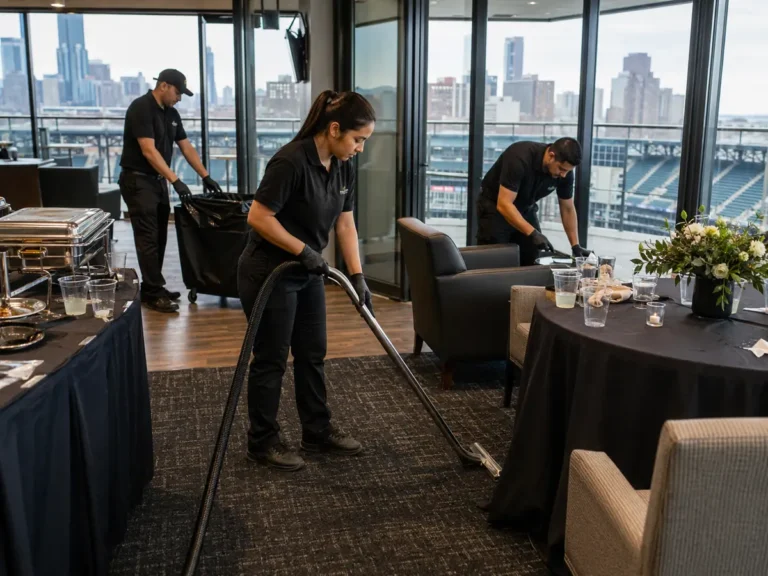
Two blocks east, Rate Field at 333 W. 35th Street — home of the Chicago White Sox since 1991, previously named Comiskey Park, U.S. Cellular Field, and Guaranteed Rate Field before the 2025 rebrand — seats 40,615 for baseball and holds a concert attendance record of 47,754. (Wikipedia: Rate Field) Its 85 private suites, four party suites, and Upper Terrace event space accommodate groups from 10 to 350 for game-day hospitality and non-game-day corporate events year-round. The Illinois Sports Facilities Authority, which owns the stadium, notes that Rate Field offers the concourse, the field itself, the parking lots, and multiple private meeting spaces for non-game events. Suite and hospitality cleanup at Rate Field after a 100-person catered corporate event — with food service, open bar, and concourse foot traffic — is fundamentally different from cleaning a gallery or loft venue, but it sits within the same three-block corridor on the same night.
Research on post-event surface recovery in industrial loft buildings is relevant here. According to the Building Owners and Managers Association (BOMA International), floors in commercial buildings are among the most visible indicators of building condition and maintenance quality — and floors in repurposed industrial buildings carry the added complexity of original materials that have not been engineered to the tolerances of modern commercial construction. Reclaimed granite brick is porous at the joint lines and chemically reactive to acidic cleaners in the same way as natural stone. Timber loft hardwood floors in an 1911 building have grain depth and finish characteristics that respond differently to beverage saturation than modern prefinished hardwood. Original concrete floors with a century of use carry micro-cracks and unsealed zones that absorb organic residue in ways that modern epoxy-coated surfaces do not.
These are the cleaning problems the next sections address — venue by venue, surface by surface, building protocol by building protocol.
Bridgeport's Venue Map — Three Distinct Surface Environments on One Corridor
Bridgeport Art Center — Skyline Loft (1200 W. 35th St., 5th Floor)
Bridgeport Art Center — Sculpture Garden Gallery (1200 W. 35th St., Ground Floor)
Zhou B Art Center (1029 W. 35th St.)
Rate Field — Suite, Terrace, and Hospitality Event Spaces (333 W. 35th St.)
Rate Field, owned by the Illinois Sports Facilities Authority, offers 85 private suites accommodating groups of 10 to 100, four party suites, the Upper Terrace event space (80–350 guests with private outdoor terrace and downtown skyline view), a press conference auditorium, concourse zones, and parking lot event areas for corporate receptions and product launches. Suite flooring is carpeted or hard-surface commercial depending on the suite configuration. Post-event suite cleanup after a full catered corporate event means carpeted floor recovery under the CRI 204 Commercial Standard — structured vacuum sequence before any wet treatment, CRI Seal of Approval-aligned extractor methodology for severe spill scenarios — combined with hard-surface concourse zones, restroom reset, and food service corridor remediation. Non-game-day events and game-adjacent private parties create different cleanup profiles depending on whether concourse areas are involved.
The Specific Risks Nobody Identifies Until the Building Manager's Morning Check
Reclaimed Granite Brick Porosity in the Sculpture Garden
Timber Loft Hardwood Saturation at the Skyline Loft
Zhou B Gallery — Millions of Dollars in Artwork Adjacent to Every Guest Circulation Zone
CRI 204 Carpet Recovery in Rate Field Suites
Freight Elevator Interior at Bridgeport Art Center
How We Clean a Bridgeport Event — Industrial Surface First, Gallery Protocol Always
Step 1: Venue Classification, Surface Confirmation, and Art Position Pre-Mapping
Before any crew arrives: building type (industrial loft, gallery-integrated event space, stadium suite), surface type per zone (1911 hardwood, reclaimed granite brick, sealed concrete, carpeted suite, original metal elevator), and art position confirmation at Zhou B (entire space) and Bridgeport Art Center Sculpture Garden (integrated sculptural installations). Art positions designated as no-contact or no-spray zones before cleaning begins.
Step 2: Sculpture Garden Reclaimed Granite Brick — Particulate First, pH-Neutral Throughout
For the Bridgeport Art Center Sculpture Garden, the sequence is: dry particulate and grit removal from the reclaimed granite brick surface before any liquid application — grit in motion under a mop on reclaimed granite brick abrades the joint lines and surface finish. pH-neutral stone-safe chemistry applied with direct technique near sculptural installations. No spray-bottle application near integrated artworks. No acidic product on the granite brick surface under any circumstances.
Step 3: Skyline Loft Hardwood — Dry Residue Treatment Before Wet Application
For the 1911 hardwood floors of the Skyline Loft, dry debris removal first, then absorbent treatment of beverage-saturated zones before any liquid cleaner is introduced to the floor surface. Hardwood-safe pH-neutral cleaning solution applied with controlled low-moisture technique. Freight elevator interior cleaned with surface-confirmed chemistry appropriate for its original metalwork and wood panel composition.
Step 4: Zhou B Gallery — No-Spray Protocol Throughout
The entire 28,000-square-foot Zhou B event space is treated as an art-proximity no-spray zone. All floor cleaning uses direct-application non-aerosol methods. Non-volatile chemistry confirmed before deployment in the gallery air environment. No exceptions for any section of either gallery floor.
Step 5: Rate Field Suites — CRI 204 Carpet Sequence
Carpeted Rate Field suite interiors: structured vacuum using Seal of Approval-aligned equipment before any liquid application. Spot treatment of isolated food and beverage stains with non-residue chemistry. Hot water extraction only where scope pre-confirms it and equipment access is cleared through stadium operations. Hard-surface concourse and corridor zones: dry debris removal, neutral floor cleaner with controlled moisture.
Step 6: Catering and Bar Zone Priority Remediation
All bar service areas, catering stations, and food corridors receive priority treatment — beverage residue and food debris addressed before general floor cleaning begins, to prevent residue migration across the floor during the main sweep. Organic waste separated from recyclables and general waste.
Why Bridgeport Event Organizers Call Us Instead of a Standard Cleanup Crew
1. We Distinguish 1911 Hardwood from Modern Prefinished Hardwood
2. Reclaimed Granite Brick Gets Natural Stone Protocol
3. Zhou B Gallery — No-Spray, Entire Space
4. Rate Field Suites Follow CRI 204 Commercial Carpet Standard
5. Integrated Sculptural Installations Are Pre-Mapped as No-Contact Zones
6. The Freight Elevator Is a Surface-Specific Cleanup Problem
7. OSHA-Aligned Chemical Handling Throughout
Bridgeport Event Cleaning Case Studies
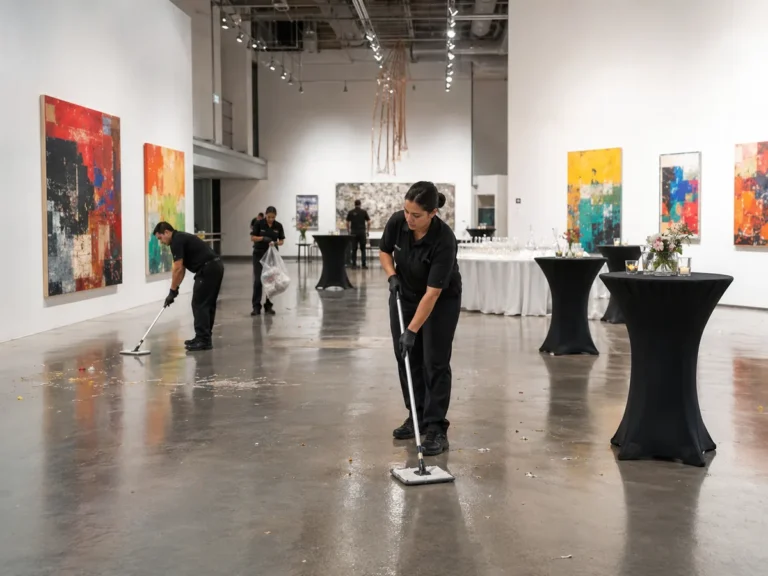
Bridgeport Event Cleaning Case Studies
Case Study 1: Bridgeport Art Center Skyline Loft — Corporate Gala, Hardwood Floor and Freight Elevator
Client type: Corporate event director Guest count: 550 (standing reception + seated dinner conversion) Venue footprint: Skyline Loft (18,000 sq ft, original 1911 hardwood floor), freight elevator interior, restrooms, service corridor Timeline: 4-hour cleanup window, 8 AM building operations opening
The problem:
A 550-person corporate gala with open bar and catering stations had saturated the original hardwood floor in two zones near the bar setups with beer and wine residue. A wet mop applied first would drive that residue deeper into the grain of century-old hardwood and activate tracked-in grit as a surface abrasive. The freight elevator interior had accumulated residue from 550 guests’ worth of rides plus bar service inside the cab. The 8 AM building operations opening was a hard deadline.
What we did:
Skyline Loft: dry debris removal across the full 18,000 sq ft hardwood surface first. Beverage-saturated zones treated with absorbent application before any liquid cleaner was introduced. Hardwood-safe pH-neutral cleaning solution applied with controlled low-moisture technique across the full floor. Freight elevator: surface material confirmed as original metalwork and wood panel — cleaning chemistry confirmed appropriate before any product was applied to the cab interior. Catering zones cleared and documented. Restrooms fully reset. Zone photographs produced before 7:45 AM.
Outcome
No hardwood grain raise, no tacky residue, no surface damage findings at 8 AM building operations opening. Event director received complete zone documentation before the building reopened. Client name withheld for confidentiality.
Case Study 2: Bridgeport Art Center Sculpture Garden — Wedding Reception, Reclaimed Granite Brick and Outdoor Zone
Client type: Private event coordinator Guest count: 420 Venue footprint: Sculpture Garden Gallery indoor zone (12,000 sq ft reclaimed granite brick floor, sculptural installations), covered outdoor zone (3,000 sq ft, brick railway arch boundaries), restrooms Timeline: 3.5-hour cleanup window, 9 AM venue operating hours
The problem:
A 420-person wedding reception had generated food and beverage residue on a reclaimed granite brick floor with three permanent sculptural installations integrated into the floor plan. The covered outdoor zone under the railway arches had food packaging, beverage cups, and floral debris from a cocktail hour. Applying standard floor cleaner to the reclaimed granite brick without prior grit removal would grind tracked-in particulate into the brick surface and mortar joints under mop pressure. Standard spray application near the sculptural installations risked chemical overspray onto stone and stainless steel artwork surfaces.
What we did:
Reclaimed granite brick: dry particulate removal across the full indoor floor surface before any liquid application. Sculptural installation positions mapped and designated as no-spray zones. pH-neutral stone-safe chemistry applied with direct technique in all zones — no spray bottles used anywhere in the sculpture garden space. Outdoor covered zone: dry debris collection first (equipment access limited by railway arch boundaries — hand-collection method used throughout), then surface treatment. Restrooms fully documented. Zone photographs produced before 8:50 AM.
Outcome
No granite brick surface etching, no joint mortar damage, no sculptural installation contact incidents. Venue manager confirmed reclaimed granite brick returned to pre-event condition at morning walkthrough. Client name withheld for confidentiality.
Case Study 3: Zhou B Art Center — Nonprofit Gala, Full Gallery Buyout
Client type: Nonprofit development director Guest count: 680 (cocktail reception across both gallery floors) Venue footprint: Ground floor gallery (14,000 sq ft), second floor gallery (14,000 sq ft), Zhou Brothers artwork installed throughout both floors Timeline: 4-hour cleanup window, gallery opens 10 AM next day
The problem:
A 680-person nonprofit cocktail gala across both Zhou B gallery floors left food and beverage residue on gallery floor surfaces with priceless Zhou Brothers artwork directly adjacent to every food and beverage service station. Standard spray-bottle floor cleaning used anywhere in the building would deposit chemical mist on exhibited artworks. The gallery venue manager had explicitly flagged that no spray application of any product was permitted in either gallery floor zone.
What we did:
Entire building designated as no-spray territory before cleaning began. Direct-application non-aerosol method used for all floor cleaning on both gallery floors. Non-volatile, gallery-confirmed chemistry deployed throughout. Floor zones cleaned systematically, section by section, on each floor. High-touch surfaces at entry, bar zones, and caterer staging areas cleaned with targeted direct application. Restrooms fully reset. Gallery floor zone photographs produced on each floor before 9:45 AM.
Outcome
No spray contact with Zhou Brothers artwork on either floor. Gallery opened on schedule. Development director received floor-by-floor zone documentation confirming no proximity incidents. Client name withheld for confidentiality.
Testimonials
⭐⭐⭐⭐⭐
“The Skyline Loft has 1911 hardwood floors — not modern prefinished flooring. After 550 guests and open bar service, those floors needed the right sequence. Abdullah’s team treated the residue before mopping and had documentation before 8 AM. No grain raise, no issues.” Corporate Event Director | Bridgeport Art Center Skyline Loft
⭐⭐⭐⭐⭐
⭐⭐⭐⭐⭐
Bridgeport Event Cleaning Pricing
Skyline Loft Hardwood Floor Cleanup (1911 hardwood, timber loft, freight elevator) — up to 18,000 sq ft
Sculpture Garden Gallery Cleanup (reclaimed granite brick, sculptural installations, outdoor zone)
Zhou B Art Center Gallery Cleanup (no-spray protocol, full gallery footprint, 2 floors)
Rate Field Suite and Hospitality Event Cleanup (carpeted suites, CRI 204 protocol)
Combined Skyline Loft + Sculpture Garden Cleanup (same-night both spaces)
Zhou B Full Buyout or Multi-Floor Corporate Event
FAQs About Event Cleaning Services in Bridgeport Chicago
Can you clean the Bridgeport Art Center Skyline Loft after an event?
Yes. We use the correct sequence for 1911 hardwood floors: dry debris and residue treatment before any liquid application, hardwood-safe pH-neutral chemistry with controlled low-moisture technique. We also clean the freight elevator interior with surface-confirmed chemistry appropriate for its original metalwork and wood panel composition, and produce 8 AM handback documentation.
Do you clean the Sculpture Garden Gallery at Bridgeport Art Center?
Yes. We use pH-neutral stone-safe protocol on the reclaimed granite brick floor — grit removal before wet treatment, direct-application technique near sculptural installations, no acidic products on the granite surface. We pre-map permanent sculptural installation positions as no-contact zones before cleaning begins.
Can you clean Zhou B Art Center after a gala or wedding?
Yes. The entire 28,000-square-foot gallery footprint is treated as a no-spray zone — no aerosol or spray-bottle application on either floor, direct-application non-aerosol methods throughout, non-volatile chemistry confirmed for the gallery air environment. We produce floor-by-floor documentation before the gallery opens.
How do you handle carpeted suites at Rate Field?
We follow CRI 204 Commercial Standard protocol: structured vacuum using Seal of Approval-aligned equipment before any liquid application — this is the required sequence for post-event heavy-traffic carpet recovery in suite environments.
Is reclaimed granite brick different from standard concrete or tile?
Yes. Reclaimed granite brick is calcium-based stone with the same chemical vulnerability as marble and limestone — acidic cleaners etch the surface. It also has porous mortar joints that absorb chemical penetration. We use pH-neutral stone-safe chemistry only, and always remove grit before wet treatment.
Can you provide building handback documentation for Bridgeport Art Center and Zhou B?
Yes. Zone photographs, surface condition confirmation, and handback records are produced before morning building operations open — not after the building manager calls.
How far in advance should I book for a Bridgeport event?
Standard venue events: 1–2 weeks. Skyline Loft multi-zone, Sculpture Garden outdoor access, Zhou B full-gallery, or Rate Field non-game-day corporate events: 3–4 weeks minimum.
Bridgeport's Event Venues Are Built From Chicago's Industrial History. The Surfaces Reflect 125 Years of It.
An 18,000-square-foot fifth-floor loft in a 1911 Classical Revival warehouse. A reclaimed granite brick sculpture garden under original railway arches. 28,000 square feet of gallery space surrounding millions of dollars in contemporary artwork. A 40,615-seat stadium suite corridor on the South Side.
These surfaces are not interchangeable. They require surface knowledge built from understanding what they actually are — not what they look like at first glance.
Call before the event ends — not after the building manager finds out what happened to the reclaimed granite brick.
✅ Bridgeport Art Center Skyline Loft 1911 hardwood floor protocol
✅ Sculpture Garden reclaimed granite brick pH-neutral stone care
✅ Freight elevator original material surface cleaning
✅ Zhou B Art Center full no-spray gallery protocol throughout
✅ Rate Field suite CRI 204 carpet cleaning sequence
✅ Sculptural installation no-contact pre-mapping
✅ Zone handback documentation before morning building operations
✅ OSHA-aligned chemical safety SOPs throughout
📍 Serving Bridgeport, West 35th Street arts corridor, Bridgeport Art Center, Zhou B Art Center, Rate Field, Central Manufacturing District venue spaces, South Branch Chicago River corridor events, and adjacent Armour Square, Canaryville, and McKinley Park neighborhood event spaces