Event Cleaning Services in Near North Side Chicago
Near North Side Event Cleaning for Navy Pier, Newberry Library, River North Galleries, Gold Coast Venues, Magnificent Mile Corporate Events, Streeterville Galas, and High-Rise Building Event Spaces
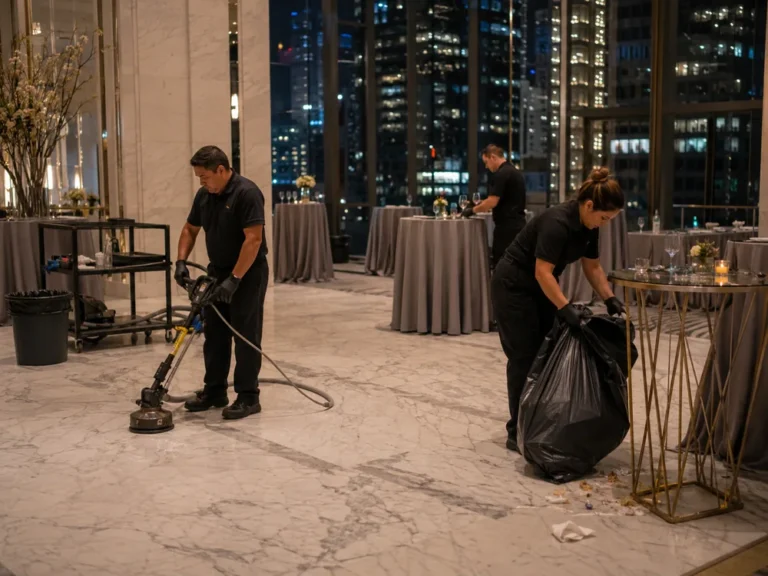
Event Cleaning Chicago provides post-event cleaning services in Near North Side for corporate event directors, convention managers, hotel event coordinators, gallery reception managers, high-rise building event operators, nonprofit gala planners, luxury venue managers, and private club event staff who need same-night marble and stone floor recovery, exhibit-adjacent surface remediation, high-rise access coordination, restroom reset at scale, waste removal, catering zone cleanup, and BOMA-aligned building handback documentation before morning building operations resume.
⭐⭐⭐⭐⭐ 5.0 Rating | 100+ Chicago Events Cleaned | IICRC S210 Stone Surface Protocol Informed | BOMA/Chicago Building Standards Aware | OSHA-Aligned Chemical Safety SOPs | Bonded & Fully Insured | Luxury Surface and High-Volume Convention Cleaning
"The Gala Wrapped at 11. The Building Manager Expects the Lobby Marble Returned Spotless by 7 AM. And You Have 500 Guests' Worth of Catering Residue on a Floor That Cost More Per Square Foot Than Most Chicago Apartments."
That is the specific post-event pressure of a Near North Side venue.
Near North Side, Chicago is Community Area 08 — the northernmost of the three central Chicago community areas, covering 2.72 square miles with a 2020 population of 105,481 residents, making it the most populous and most densely populated community area in the entire city, at approximately 38,800 people per square mile. (Wikipedia: Near North Side, Chicago) Its sub-neighborhoods include River North, Chicago’s gallery district and one of the country’s highest-density concentrations of art galleries; the Gold Coast, one of the most affluent residential neighborhoods in the United States, lined with 19th-century Astor Street mansion architecture; Streeterville, home of Navy Pier and the lakefront; and the Magnificent Mile, the 13-block stretch of North Michigan Avenue that functions as Chicago’s primary luxury retail and corporate corridor. (Wikidata: Near North Side)
The density of Near North Side’s event infrastructure is unlike any other Chicago neighborhood — and so is the surface complexity of its venues.
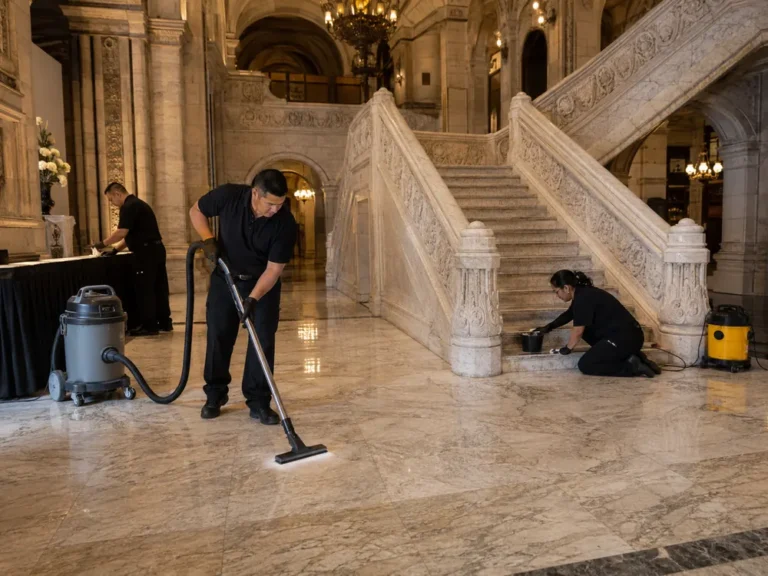
Navy Pier’s Event Center alone encompasses 18,000 square feet in the Aon Grand Ballroom (part of the Pier’s original 1916 construction with an 80-foot domed ceiling), 170,000 square feet of divisible exhibit space in Festival Hall across Hall A (113,000 sq ft) and Hall B (57,000 sq ft), and 34 adjacent meeting rooms — all on a lakefront pier structure with outdoor boardwalk zones, rooftop terrace access, and tight morning turnaround windows for the Pier’s daily public operations. (Navy Pier: Festival Hall) The Newberry Library, founded in 1887 and home to 1.6 million books and 5 million manuscript pages, hosts cocktail galas and board dinners for up to 208 guests in its Romanesque-style lobby featuring a grand marble staircase and Art Nouveau chandelier — marble surfaces that require IICRC S210-informed cleaning protocol, not standard floor product. (Wikipedia: Newberry Library) River North’s gallery and restaurant event district offers dozens of private event spaces — from the 6,000-square-foot RPM Events complex overlooking the Chicago River to intimate gallery buyout spaces where food and beverage service occurs within feet of exhibited artwork.
The defining risk of Near North Side event cleaning is surface luxury combined with building-management accountability.
BOMA/Chicago — the Building Owners and Managers Association of Chicago, representing 245 commercial offices and institutional buildings since 1902, and covering approximately 80 percent of all rentable Class A downtown office space — establishes the operational standard that Near North Side high-rise building managers apply when evaluating post-event cleanup. BOMA International notes directly: “Floors are the heart and soul of every building, and they’re one of the first things a visitor will notice when they walk through the door.
A well-kept floor immediately signals that the building is clean and maintained with care.” For a Near North Side building manager overseeing a marble lobby used as a gala venue, that standard is not aspirational — it is the basis for evaluating whether the event organizer’s cleanup vendor can be authorized to return.
The IICRC S210 standard for stone and tile cleaning and restoration provides the technical baseline for marble and natural stone floor care in high-traffic commercial settings. Marble is composed of calcium carbonate — the same mineral structure present in Rockefeller Chapel’s limestone nave floors. Acidic cleaning agents, including citrus-based degreasers and many multi-surface sprays, etch marble on contact, producing dull, irreversible surface damage that requires professional restoration to correct, not additional cleaning. Post-event marble care requires pH-neutral chemistry, grit and particulate removal before any liquid application, and controlled low-moisture technique — a sequence that has nothing in common with how a standard cleaning crew mops a floor after a party.
Research on high-traffic stone floor maintenance from MARBLELIFE Chicago, a stone restoration firm operating in Chicago’s hotel and office building market, identifies the key mechanism of accelerating marble damage in event settings: foot traffic after a catered event embeds fine particulate and grit from guests’ shoes into the stone surface under body weight. Each subsequent footstep acts as a micro-abrasive pass against the marble finish. The damage is cumulative, invisible to the naked eye during the event, and only apparent days or weeks later as a generalized loss of surface sheen. Removing that grit before any wet cleaning begins is not a preference — it is the only method that prevents progressive surface degradation.
Beyond marble, Near North Side’s event footprint also generates high-rise building access complexity that no other Chicago neighborhood matches at the same density. BOMA/Chicago‘s member buildings include nearly 100 percent of downtown Class A rentable space — the majority of which is concentrated in River North, Streeterville, and the Magnificent Mile corridor. High-rise building managers in these buildings operate under service elevator schedules, after-hours access protocols, loading dock reservation windows, and waste removal routes that are governed by building operations staff. An event cleanup crew that arrives without pre-confirmed access, attempts to use a passenger elevator with equipment, or leaves waste staging in an unauthorized corridor does not just create an operational problem. They create a building management relationship problem that affects the event organizer’s future access to the same venue.
What this means in practice — for every venue from Navy Pier’s 170,000-square-foot Festival Hall to a 3,000-square-foot River North gallery reception space — is covered in the sections below: surface by surface, zone by zone, building access protocol by protocol.
Near North Side's Venue Map — Five Distinct Cleaning Challenges in One Neighborhood
Navy Pier Event Center (600 E. Grand Ave., Streeterville)
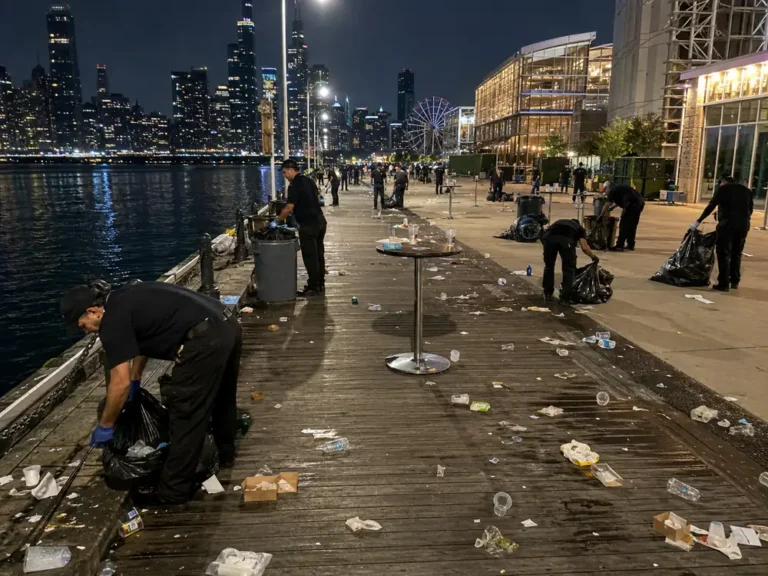
Navy Pier is Chicago's most-visited attraction with more than 8 million annual visitors, and its Event Center spans Festival Hall (170,000 sq ft, 60-foot ceilings, 8-truck loading dock), the Aon Grand Ballroom (18,000 sq ft, 80-foot domed ceiling, 1,100 dinner / 300 balcony seating), the Lakeview Terrace, and an outdoor boardwalk with lakefront exposure. (Wikipedia: Navy Pier Auditorium) Post-event cleanup at Navy Pier requires zone-team deployment across multiple simultaneous spaces, outdoor boardwalk debris clearing with lakefront wind exposure, and handback to Pier operations before public opening — a hard deadline that cannot slip.
Newberry Library (60 W. Walnut St., Near North)
The Newberry Library, founded in 1887 and one of the country's leading independent humanities research libraries, hosts galas and corporate dinners for up to 208 guests in its Romanesque-style lobby with a grand marble staircase, Art Nouveau chandelier, and Steinway grand piano. Its Rettinger Hall and Baskes Boardroom feature marble floors and specialty recessed lighting. (Unique Venues: Newberry Library) All of these surfaces require IICRC S210-informed post-event protocol: particulate removal before liquid application, pH-neutral chemistry confirmed for marble and stone, and no standard floor products near the library's rare book collection rooms.
River North Gallery and Restaurant Event District
River North is one of the highest-density art gallery districts in the country — and many of those galleries host corporate receptions, donor events, and product launches with food and beverage service occurring adjacent to exhibited artwork. Post-event cleanup in gallery spaces requires chemistry clearance in proximity to artwork, careful handling of polished concrete and resin-sealed gallery floors, and coordination with gallery staff on artwork proximity zones before any spray product is deployed. The River North restaurant event complex adds marble-topped bars (Salon 61's harlequin marble floor), polished wood surfaces, and rooftop terrace zones to the same neighborhood cleanup scope.
Gold Coast Historic Venues and Mansion-Style Event Spaces
The Gold Coast district along Astor Street features 19th-century mansions and historic revival buildings that have been converted to private event use — including the International Museum of Surgical Science in a lakefront mansion, the former Playboy Mansion, and the Charnley-Persky House designed by Louis Sullivan and Frank Lloyd Wright. These spaces have original hardwood floors, plaster walls, and architectural details that cannot tolerate standard commercial floor chemistry or moisture-heavy cleaning approaches.
Magnificent Mile and Streeterville High-Rise Venue Spaces
The Magnificent Mile, the 13-block stretch of North Michigan Avenue from the Chicago River to Oak Street, is lined with luxury hotels, corporate headquarters, and high-rise retail buildings that host private events in their ballrooms, event floors, and terrace spaces. Cleanup in these buildings operates under BOMA/Chicago member building protocols: service elevator reservations, loading dock windows, waste staging rules, and documented handback to building facilities management before the building's next operational window.
The Risks That Don't Show Up Until the Building Manager's Morning Walk-Through
Marble Etching From the Wrong Post-Event Chemistry
The Newberry Library lobby's grand marble staircase, Salon 61's harlequin marble floor, and the marble-surfaced bars and lobbies common to Gold Coast and Magnificent Mile event spaces share the same chemical vulnerability: they are calcium carbonate stone surfaces that etch permanently on contact with acidic cleaning products. IICRC S210 specifies that stone surfaces require pH-neutral chemistry and that acid-based or multi-surface cleaners cause etching that cannot be corrected by cleaning alone — only by professional restoration. A single post-event wipe-down with a citrus degreaser on a marble lobby floor costs the venue manager a stone restoration bill in the morning. We use pH-neutral chemistry confirmed safe for marble and natural stone on every surface where the substrate is calcium-based.
Grit Embedding Under Foot Traffic in Post-Event Marble Lobbies
MARBLELIFE Chicago identifies progressive grit abrasion as the primary mechanism of marble surface degradation in high-traffic commercial settings. After a 500-person gala, guests tracking in particulate from the Pier's outdoor boardwalk, the Gold Coast sidewalks, or the Magnificent Mile pavement embed abrasive grit into the marble surface under bodyweight. Each footstep during cleanup is another abrasive pass. The correct sequence — grit and dry particulate removal before any liquid application — prevents this entirely. The incorrect sequence — mopping first — drives grit deeper into the surface and accelerates the damage.
High-Rise Building Access Failure
BOMA/Chicago member buildings — covering approximately 80 percent of downtown Class A office space — operate after-hours cleaning access under service elevator schedules, loading dock reservation windows, and waste staging zone rules. A cleanup crew that arrives at a Magnificent Mile high-rise without pre-confirmed service elevator access, attempts to move floor equipment through the main lobby, or leaves waste in an elevator lobby rather than a designated staging zone does not just create operational friction. They breach the building management access agreement and create a compliance record that follows the event organizer's venue relationship. We pre-confirm all access details — service elevator scheduling, loading dock windows, waste staging locations, and building contact — before the cleanup crew arrives.
Gallery Art Proximity Chemistry Contamination
River North gallery event spaces require cleaning chemistry cleared in proximity to exhibited artwork. Spray application of multi-surface cleaners in a gallery space — even on the floor — creates airborne chemical mist that can deposit on canvas, sculpture, and framing materials. AAM's collections care guidance notes that standard commercial cleaning products can cause damage to cultural property when applied without surface-specific protocols in institutional spaces. In a River North gallery reception where food service occurred adjacent to exhibited pieces, we restrict spray application near artwork, use targeted application methods, and confirm the gallery's proximity rules before deploying any product.
Navy Pier Lakefront Wind and Outdoor Boardwalk Debris
Navy Pier extends six city blocks into Lake Michigan. Its outdoor boardwalk, rooftop terrace, and east-end exterior zones are exposed to sustained lakefront wind that moves lightweight debris — napkins, cups, promotional materials, food packaging — across the boardwalk surface and toward the pier's lake-edge railings during and after events. Post-event outdoor zone cleanup at Navy Pier requires a perimeter-first approach: the lake-edge zones are cleared before the main boardwalk sweep, not after. Debris left near the pier's lake edge during cleanup is a literal loss-to-water risk.
Convention-Scale Waste Volume in Festival Hall
Festival Hall's 170,000 square feet can host 600 trade show booths in Hall A alone. A full-hall trade show or corporate expo generates booth construction debris, branded signage waste, food vendor residue, and attendee-generated packaging across a footprint the size of three full city blocks — indoors, with 60-foot ceilings and an 8-truck loading dock as the only exit. Zone-team deployment with parallel section clearing and waste stream separation is not an operational option at this scale — it is the only approach that clears 170,000 square feet within a single overnight window.
How We Clean a Near North Side Event — Luxury Surfaces First, Scale Second
Step 1: Surface Classification and Building Access Pre-Confirmation
Before anything else: surface type confirmation across every zone (marble, polished stone, gallery resin floor, high-rise lobby tile, exposed concrete, outdoor pier surface) and building access pre-confirmation (service elevator schedule, loading dock window, waste staging location, building contact, access code or escort requirement). Neither step is optional.
Step 2: Grit and Dry Particulate Removal — Before Any Liquid Contact on Stone
On every marble, limestone, polished stone, or calcium-based surface, the first action is dry particulate removal using soft-bristle equipment. No wet treatment begins until the surface is free of tracked-in grit and dry debris. This sequence protects the stone surface from progressive abrasion and prevents grit from being activated as an abrasive agent by wet mopping.
Step 3: pH-Neutral Chemistry on All Marble and Natural Stone Zones
All cleaning products used on marble staircases, stone lobby floors, marble bar surfaces, and natural stone tile receive pH-neutral chemistry confirmed safe for calcium carbonate stone — no acidic agents, no citrus degreasers, no alkaline strippers. This applies to the Newberry Library's marble lobby, Gold Coast mansion hardwood-adjacent stone entries, and Magnificent Mile hotel marble floors equally.
Step 4: Gallery Art Proximity Protocol
In River North gallery spaces, any zone within 6 feet of exhibited artwork is treated as a restricted spray zone. Floor cleaning in art-proximity zones uses targeted, direct-application methods — no aerosol or spray distribution. Chemistry is confirmed non-volatile and cleared for use in the gallery's air environment before deployment.
Step 5: Catering and Bar Zone Priority Remediation
Bar tops, passed-food staging stations, cocktail tables, and catering service corridors are treated as priority zones — cleaned before general floor recovery to prevent food residue and beverage spill from migrating to adjacent surfaces via foot traffic. Marble bar tops receive the same pH-neutral protocol as marble floors. Wood bar tops and parquet surfaces receive surface-confirmed chemistry appropriate for the specific finish type.
Step 6: Restroom Reset — Documented Per Unit
Every restroom is cleaned, disinfected, and restocked individually. In Near North Side venues with high guest counts — Navy Pier galas at 1,100+ seated, RPM Events at 425, Newberry Library at 208 — restrooms receive concentrated post-event saturation that requires a full reset sequence, not a wipe-and-restock. Each restroom unit is documented as a separate completion record.
Step 7: Outdoor Zone Clearing — Perimeter-First at Navy Pier and Rooftop Venues
For Navy Pier boardwalk events and Magnificent Mile rooftop terrace events, outdoor clearing begins at the perimeter (lake edge at Navy Pier, building edge at rooftop venues) and works inward. Lightweight debris — cups, napkins, promotional materials — at lake-edge or high-rise-edge zones is collected before any sweeping begins, to prevent wind movement of debris toward unrecoverable zones.
Step 8: Waste Stream Separation and Building Handback Documentation
Waste is separated into recyclables, organic waste, and general trash according to the venue or building's plan. For BOMA/Chicago member building events, we produce zone photographs, access route clearance confirmation, and surface handback documentation before the building facilities manager's first morning walkthrough. Nothing is communicated verbally — the event organizer and building manager receive written documentation.
Why Near North Side Event Organizers and Building Managers Call Us
Marble Protocol Is Standard, Not an Upsell
Every marble surface — Newberry Library staircase, Salon 61 harlequin floor, Gold Coast lobby tile — receives IICRC S210-informed post-event protocol: grit removal first, pH-neutral chemistry, controlled moisture. We do not apply standard floor product to calcium carbonate stone.
BOMA/Chicago Building Access Requirements Are Pre-Confirmed
Service elevator schedules, loading dock windows, waste staging locations, and building contact protocols are confirmed before the crew arrives — not improvised on-site. This protects the event organizer's building management relationship.
Gallery Art Proximity Is a Restricted Chemistry Zone
River North gallery events receive art-proximity protocol: no spray application near exhibited work, targeted direct application only, non-volatile chemistry in all gallery-adjacent zones.
Navy Pier Scale Is Handled by Zone Teams, Not a Single Crew
Festival Hall's 170,000 square feet cannot be cleared in one direction by one crew in an overnight window. We deploy zone teams working parallel sections with waste consolidation at the 8-truck loading dock.
Outdoor Boardwalk and Rooftop Zones Get Perimeter-First Clearing
At Navy Pier and Magnificent Mile rooftop events, outdoor clearing starts at the lake edge or building edge — where wind-moved debris cannot be recovered — and works inward. This is not how standard cleanup crews approach outdoor zones.
High-Rise Building Handback Documentation Is Standard
Cleaning records, zone photographs, surface condition confirmation, and access route clearance documentation are generated before we leave — not summarized the next day. BOMA/Chicago member building managers receive the documentation package they need for their own operational records.
OSHA-Aligned Chemical Handling Throughout
All products — pH-neutral stone cleaners, degreasers, disinfectants, surface-specific floor solutions — are handled under OSHA Hazard Communication standards: labeled containers, current Safety Data Sheets, correct dilution ratios, PPE throughout.
Near North Side Event Cleaning Case Studies
Case Study 1: Newberry Library — Corporate Gala, Marble Lobby and Romanesque Entry
Client type: Corporate event director Guest count: 190 Venue footprint: Romanesque lobby (marble staircase, marble floor, Art Nouveau chandelier), Ruggles Hall (wood-paneled walls, parquet floor), Rettinger Hall (marble floor) Event type: Corporate gala with cocktail reception and seated dinner Timeline: 3.5-hour cleanup window, 8 AM library facilities review
The problem:
190 guests tracked particulate from the Washington Square Park sidewalk across the Newberry Library's marble lobby floor throughout the evening. By event close, the lobby marble showed tracked-in grit, cocktail spill marks near the bar setup positions, and food residue from passed hors d'oeuvres adjacent to the grand staircase. Ruggles Hall's parquet floor had concentrated foot traffic and beverage residue near the dinner tables. The library's facilities manager required signed handback documentation at 8 AM confirming surface condition restoration.
What we did:
Marble lobby: soft-bristle grit removal across the full floor surface before any liquid application. pH-neutral stone-safe chemistry applied with controlled low-moisture technique — no standing water on marble, no standard floor cleaner on the staircase risers. Cocktail spill marks spot-treated with targeted pH-neutral application. Ruggles Hall parquet: surface-confirmed wood-safe chemistry, dry debris first, controlled damp mopping with immediate dry-follow. Rettinger Hall marble floors: same protocol as lobby. Restrooms documented. 8 AM handback documentation with zone photographs submitted to facilities manager before review.
Outcome
No marble etching, no grit abrasion findings, no surface condition dispute at facilities review. Library facilities manager confirmed marble lobby and Rettinger Hall floors returned to pre-event condition. Client name withheld for confidentiality.
Case Study 2: Navy Pier Aon Grand Ballroom — Corporate Dinner Gala with Outdoor Boardwalk Reception
Client type: Conference and events director Guest count: 1,050 (dinner) + 300 (balcony) = 1,350 total Venue footprint: Aon Grand Ballroom (18,000 sq ft), balcony (300-seat), outdoor boardwalk reception zone (approx. 12,000 sq ft), 6 adjacent meeting rooms Event type: Multi-component corporate conference gala Timeline: 4-hour cleanup window, 6:30 AM Pier operations opening
The problem:
1,350 guests across the Ballroom, balcony, and outdoor boardwalk generated a multi-zone waste and surface problem with a 6:30 AM hard deadline. The outdoor boardwalk zone had wind-moved debris — napkins, cups, beverage waste — that had migrated toward the pier's lake-edge railings during the event. The Ballroom floor (sealed institutional hard surface) had 1,350 covers' worth of foot traffic, food debris, and beverage residue. Six adjacent meeting rooms had post-session paper waste and beverage spill. The Pier's loading dock required all waste removed through the 8-truck dock by 6 AM to clear the morning public access route.
What we did:
Outdoor boardwalk team started immediately at event close: lake-edge perimeter cleared first, debris collected from railing zones, boardwalk swept section by section inward. Parallel indoor teams: Ballroom cleared using 4-section zone deployment, balcony cleared as a separate zone, 6 meeting rooms assigned to a dedicated 2-person team. Dry debris removal on Ballroom floor before wet treatment. Waste consolidated and staged at loading dock by 5:45 AM. All zones photographed. Handback documentation transmitted to event director before 6:30 AM opening.
Outcome
Pier operations opening met without delay. Waste cleared from loading dock before the 6 AM window. Event director received complete zone documentation before morning handover. Client name withheld for confidentiality.
Case Study 3: River North Gallery — Donor Reception, Art-Adjacent Surface Cleanup
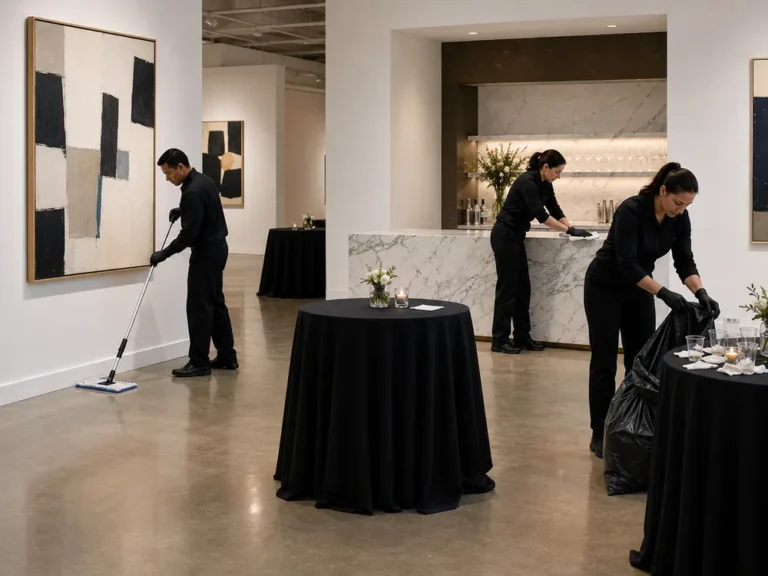
Client type: Nonprofit development director Guest count: 165 Venue footprint: Main gallery floor (resin-sealed concrete, approx. 3,800 sq ft), bar alcove (marble bar top), outdoor patio (sealed concrete) Event type: Donor reception with passed food and open bar service Timeline: 3-hour cleanup window, gallery re-opening next morning
The problem:
A 165-person donor reception with open bar and passed catering left food residue and beverage spill on a resin-sealed gallery floor with exhibited artwork within 3–5 feet of the food service stations. Standard spray application of floor cleaner near the gallery walls would create chemical mist in proximity to exhibited canvases. The marble bar top in the alcove had cocktail rings and bar residue from 3 hours of open bar service. The outdoor patio had beverage cup and napkin debris.
What we did:
Gallery floor: all zones within 6 feet of exhibited artwork designated restricted spray zones. Direct-application, non-aerosol method used for floor cleaning in art-proximity areas. Non-restricted zones cleaned with resin-safe neutral chemistry using standard controlled application. Marble bar top: pH-neutral marble-safe solution applied with direct wipe technique — no spray, no acidic product. Outdoor patio cleared with dry sweep first, then rinse. Restrooms documented. Zone photographs produced.
Outcome
Gallery re-opened with no surface findings, no artwork proximity incidents. Development director received handback documentation confirming all art-proximity zones cleaned to gallery's protocol. Client name withheld for confidentiality.
Testimonials
⭐⭐⭐⭐⭐
"The Newberry Library has marble floors and a grand staircase that cannot be cleaned carelessly. Abdullah's team removed the grit before any liquid touched the floor, used the right chemistry, and had documentation ready before our 8 AM facilities review. That's the only way it works here."
Corporate Event Director | Newberry Library, Near North Side
⭐⭐⭐⭐⭐
"Navy Pier has 1,350 guests, an outdoor boardwalk, a 6:30 AM opening, and a loading dock window. Abdullah's crew worked in parallel zones, cleared the lake-edge perimeter first, staged waste at the dock before 6 AM, and had documentation to us before the building opened. Exactly what we needed."
Conference and Events Director | Navy Pier, Streeterville
⭐⭐⭐⭐⭐
"River North gallery with exhibited artwork adjacent to the food service zones. They understood the art-proximity restriction, used direct application near the walls, handled the marble bar correctly, and got out before morning. Professional from first call to final photo."
Nonprofit Development Director | River North, Near North Side
Near North Side Event Cleaning Pricing
Pricing depends on surface type, marble and stone zone count, gallery art-proximity requirements, building access complexity, guest count, food and beverage volume, outdoor footprint, waste volume, documentation requirements, and handback deadline.
Historic Library or Museum Lobby Cleanup (marble, natural stone) — up to 4,000 sq ft
Starting at $849
River North Gallery or Restaurant Event Cleanup (resin floor, marble bar, art-adjacent)
Starting at $749
Gold Coast Mansion or Historic Venue Cleanup (original hardwood, plaster, ornamental surfaces)
Starting at $799
Navy Pier Aon Grand Ballroom or Festival Hall Partial Zone Cleanup
Starting at $1,299
Navy Pier Full Multi-Space Event Cleanup (Ballroom + boardwalk + meeting rooms)
Custom quote based on zone count and scope
Magnificent Mile or Streeterville High-Rise Building Event Cleanup
Starting at $899 plus building access coordination
FAQs About Event Cleaning Services in Near North Side Chicago
Can you clean the Newberry Library after an event?
Yes. We use IICRC S210-informed stone surface protocol on the Newberry's marble staircase, marble floors, and stone surfaces: grit removal before liquid application, pH-neutral chemistry confirmed for calcium carbonate stone, and controlled low-moisture technique. We produce 8 AM handback documentation for the library's facilities review.
Do you clean Navy Pier events?
Yes. We handle the Aon Grand Ballroom, Festival Hall, outdoor boardwalk, Lakeview Terrace, and adjacent meeting rooms using zone-team deployment and perimeter-first outdoor clearing. We coordinate waste removal to the 8-truck loading dock before the Pier's public opening window.
How do you handle marble floors and staircases after a high-traffic event?
We remove grit and dry particulate before any liquid application — this prevents foot-traffic-activated abrasion of the marble finish. We use pH-neutral chemistry confirmed safe for calcium carbonate stone. No acidic, citrus-based, or alkaline products on marble surfaces, under any circumstances.
Can you clean River North gallery event spaces with exhibited artwork?
Yes. We designate all zones within 6 feet of exhibited artwork as restricted spray zones. Direct-application, non-aerosol methods are used in art-proximity areas. Chemistry is confirmed non-volatile before deployment in gallery spaces.
Do you coordinate building access for high-rise Near North Side venues?
Yes. We pre-confirm service elevator schedules, loading dock windows, and building contacts before arrival — not on-site. BOMA/Chicago member building protocols are factored into our access plan for every high-rise event.
Can you clean Gold Coast historic mansion-style event venues?
Yes. We use surface-confirmed chemistry appropriate for original hardwood floors, plaster walls, and ornamental architectural surfaces common to 19th-century Gold Coast buildings. No standard commercial floor product on original hardwood or period architectural finishes.
Do you provide documentation for building managers after the event?
Yes. Zone photographs, surface condition confirmation, access route clearance, and waste removal records are produced before we leave — transmitted to both the event organizer and building manager as a written record, not a verbal update.
How far in advance should I book for a Near North Side event?
Standard venue events: 1–2 weeks. Navy Pier multi-zone events, BOMA/Chicago building access events, Newberry Library marble surface events, or large-scale convention cleanup: 3–4 weeks minimum.
Near North Side Events Happen on Some of Chicago's Most Valuable Surfaces. The Cleanup Has to Match.
An 1887 marble staircase in a Romanesque research library. A 1916 Grand Ballroom under an 80-foot dome on a lakefront pier. A River North gallery where the floor budget is lower than the artwork on the walls. A Gold Coast mansion with original 19th-century hardwood that has survived 130 years of Chicago winters.
These are not standard post-party venues. They require surface knowledge that goes beyond “mop the floor and take the trash.” They require the right chemistry, the correct sequence, building access coordination, and documentation that satisfies building managers before the morning walk-through.
Call before the event ends — not after the building manager discovers what the wrong floor cleaner did to a century-old marble lobby.
✅ Newberry Library marble staircase and stone floor protocol
✅ Navy Pier Festival Hall, Aon Grand Ballroom, and boardwalk cleanup
✅ River North gallery art-proximity surface protocol
✅ Gold Coast historic venue hardwood and ornamental surface care
✅ IICRC S210-informed marble and natural stone cleaning sequence
✅ BOMA/Chicago building access coordination and documentation
✅ pH-neutral chemistry on all calcium carbonate stone surfaces
✅ OSHA-aligned chemical safety SOPs throughout
📍 Serving Near North Side, Navy Pier, Streeterville, River North, Gold Coast, Magnificent Mile, Old Town, Washington Square Park area, and adjacent Goose Island and Cabrini-Green neighborhood commercial venues