Event Cleaning Services in Pilsen Chicago
Pilsen Event Cleaning for Thalia Hall, Lacuna Artist Lofts, National Museum of Mexican Art, 18th Street Arts District, Día de los Muertos at Harrison Park, Pilsen Fest, and Neighborhood Gallery and Industrial Venue Events
Event Cleaning Chicago provides post-event cleaning services in Pilsen for concert venue managers, industrial loft event coordinators, museum event staff, gallery reception managers, community festival producers, arts district event organizers, and private venue operators who need same-night sealed concrete and industrial floor remediation, cultural institution surface care, artwork-adjacent cleaning protocol, mural-adjacent outdoor site restoration, restroom reset, catering zone cleanup, and documented venue handback before morning operating hours.
★★★★★ 5.0 Rating | 100+ Chicago Events Cleaned | OSHA-Aligned Chemical Safety SOPs | AAM-Aligned Cultural Institution Cleaning Awareness | Bonded & Fully Insured | Industrial Loft, Historic Theater, and Museum Venue Cleaning | Available Concert Nights and Festival Weekends
The Concert Ended at Midnight in a 130-Year-Old Czech Opera House. The Mural Festival Wrapped in a Former Macaroni Factory. And the Día de los Muertos Celebration Just Ended on Harrison Park’s Lawn. Every Surface Is Different — and None of Them Cleans the Same Way.
That is the material reality of post-event cleanup in Pilsen.
Pilsen, Chicago is the primary neighborhood of the Lower West Side community area (Community Area 31), located approximately three miles southwest of the Chicago Loop, with a 2023 population of 33,279 and a demographic composition that is 68.4% Hispanic — predominantly Mexican-American — making it Chicago’s most significant Mexican-American cultural neighborhood. The neighborhood takes its name from Plzeň, the largest city in Bohemia, reflecting the Czech and Bohemian immigrant community that built its commercial corridor along West 18th Street in the late 19th century — the same corridor that now anchors one of the country’s most recognized Latino cultural districts.
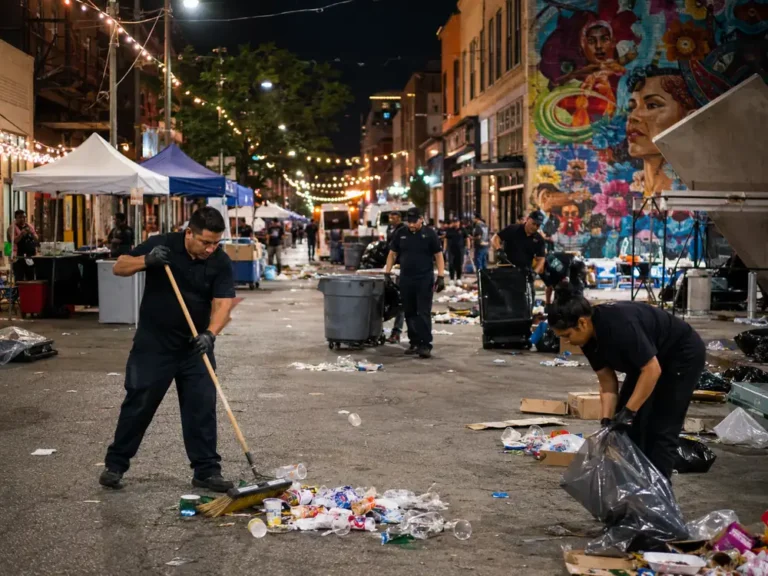
The Pilsen Historic District, added to the National Register of Historic Places on February 1, 2006 (NRHP reference No. 05001609), covers 14 blocks of the 18th Street commercial corridor and approximately 850 buildings constructed primarily in Italianate, Romanesque, and Queen Anne styles with distinctive “Bohemian Baroque” parapets, carved stone lintels, and sculptural hoodmolds — a building stock entirely different from Chicago’s Prairie School or modernist inventory. 18th Street has been named one of the coolest streets in the world; it operates simultaneously as a Mexican commercial main street, a gallery corridor, a performance venue row, and a neighborhood street lined with murals that constitute one of the largest concentrations of public art in any American urban district.
The defining challenge of Pilsen event cleaning is surface material diversity within a single neighborhood — and none of those surfaces forgives generic cleaning protocol.
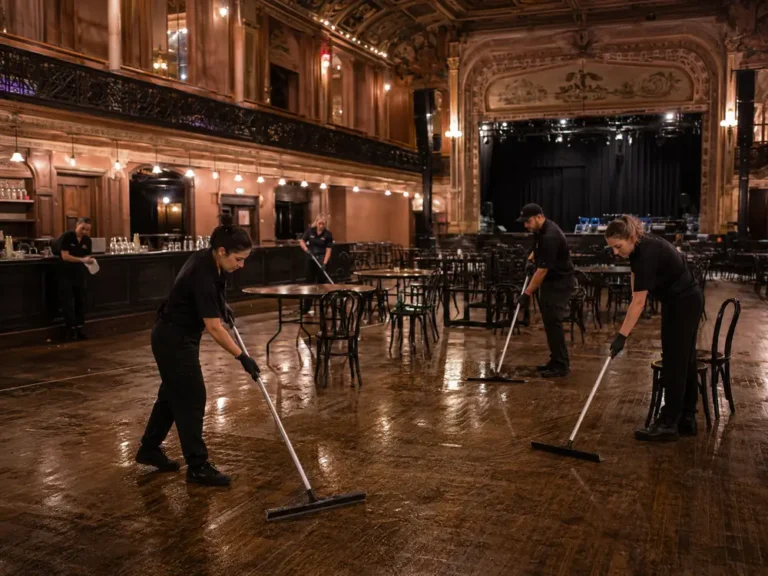
Thalia Hall, designated a Chicago Landmark on October 25, 1989, is a Romanesque Revival building completed in 1892 by architects Frederick Faber and William Pagels for Czech community leader John Dusek, modeled after the Prague Opera House. Its 5,000-square-foot main performance space has original tin ceiling panels with stained-glass inlays, a horseshoe-shaped balcony, four large opera boxes, ornate decorative moldings, and a GA floor accommodating 900 standing or 220 seated. The building also houses Dusek’s Board & Beer, the basement Punch House cocktail bar, and the Tack Room — meaning post-event cleanup spans a 1892 historic theater floor, a basement bar with its own surface profile, and a restaurant catering corridor, all within the same building.
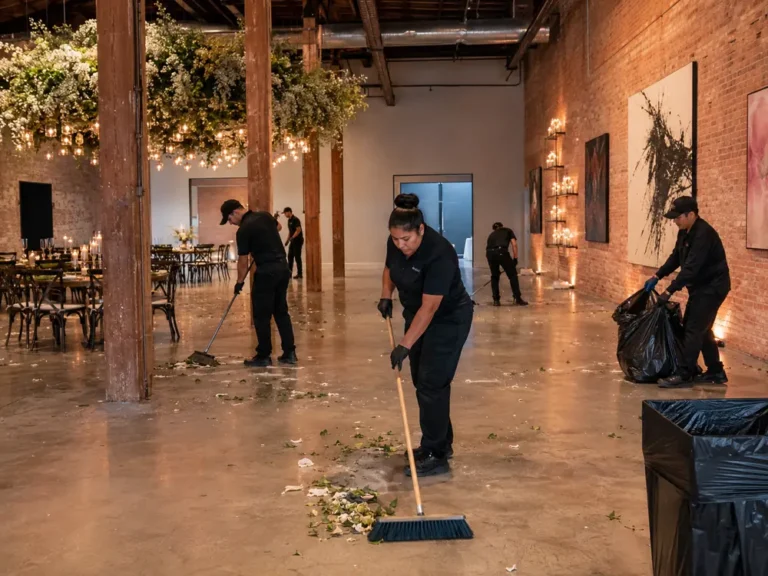
Lacuna Artist Lofts at 2150 S. Canalport, built in 1897 as the world’s largest macaroni factory, is a 5-story, 250,000-square-foot industrial complex with sealed concrete floors, exposed brick walls, timber structural framing, and reclaimed-material event spaces. The National Museum of Mexican Art (NMMA) at 1852 W. 19th Street — the only Latino museum accredited by the American Alliance of Museums and the largest Latino cultural institution in America — houses a 48,000-square-foot facility in Harrison Park with a hardwood-stage West Wing event space, floor-to-ceiling windows in the Courtyard, and gallery corridors containing permanent and rotating Mexican and Chicano art exhibitions.
Research from the AAM’s collections care framework is directly applicable at the NMMA: standard commercial cleaning products used near gallery collections can cause irreversible damage to cultural artifacts. The museum’s West Wing event space positions food and beverage service within the same building envelope as its permanent collection — requiring cleaning chemistry cleared for gallery-adjacent use, with restricted spray protocols near exhibition corridors.
Outdoor Pilsen events add a third dimension. The NMMA’s annual Día de los Muertos celebration — “Xicago” — held in Harrison Park from October 31 through November 2, draws over 10,000 visitors annually, making it the largest Día de los Muertos event in the United States. Pilsen Fest, also known as the Pilsen Arts and Music Festival, drew an estimated 50,000 attendees in 2017 across 18th Street and surrounding arts district blocks. Outdoor events on Chicago Park District property at Harrison Park operate under Chicago Park District permit requirements and DCASE Special Event Permit frameworks — with site restoration documentation required as part of the permit compliance chain.
What all of this means for a Pilsen event organizer: one neighborhood produces at least five categorically different cleaning problems — a 130-year-old historic theater with original tin and stained-glass surfaces, a 125-year-old industrial loft with sealed concrete and reclaimed-material finishes, an AAM-accredited museum gallery with hardwood stage and adjacent permanent collection, an outdoor park with ofrenda installations and food vendor footprint, and an 18th Street gallery corridor where the murals on the building exteriors are themselves protected public artworks. The sections below map each one.
Pilsen's Venue Map — Five Surface Categories, One Neighborhood
Thalia Hall (1807 S. Allport St.)
Thalia Hall is a Chicago Landmark and one of the city’s most architecturally significant performance venues — a 1892 Czech community hall with a Romanesque Revival limestone façade, original tin ceiling with stained-glass panels, ornate decorative moldings, horseshoe balcony, opera boxes, and a 5,000-square-foot main floor (900 standing / 220 seated). Its connected spaces include Dusek’s Board & Beer, Punch House, and the Tack Room. A Thalia Hall event cleanup spans at minimum three distinct surface environments in one building: the historic theater floor, the basement bar, and the restaurant service corridor.
Lacuna Artist Lofts / Lacuna Events by LM (2150 S. Canalport Ave.)
Lacuna is a 250,000-square-foot, 5-story industrial complex originally built in 1897 as the world’s largest macaroni factory, now housing 156 artist studios and 4 private event spaces: the Reverie Gallery, La Galleria, the Skydeck rooftop, and Magik Street. The building’s surfaces include original sealed concrete floors, exposed brick walls, timber structural posts, reclaimed-material installations, and artist-created elements that require art-proximity awareness even outside a formal museum setting.
National Museum of Mexican Art (1852 W. 19th St.)
The NMMA is the only AAM-accredited Latino museum in America and the largest Latino cultural institution in the country. Its event spaces include the West Wing, the Courtyard, and the second-floor Board Room. Events occur within a building that contains a permanent collection spanning pre-Cuauhtémoc antiquities, modern painting, photography, and popular art. Post-event cleanup requires gallery-adjacent surface protocol: no spray application near gallery openings, restricted chemistry, and hardwood stage recovery using surface-confirmed sequence.
Harrison Park Outdoor Events — Día de los Muertos Xicago and Park District Events
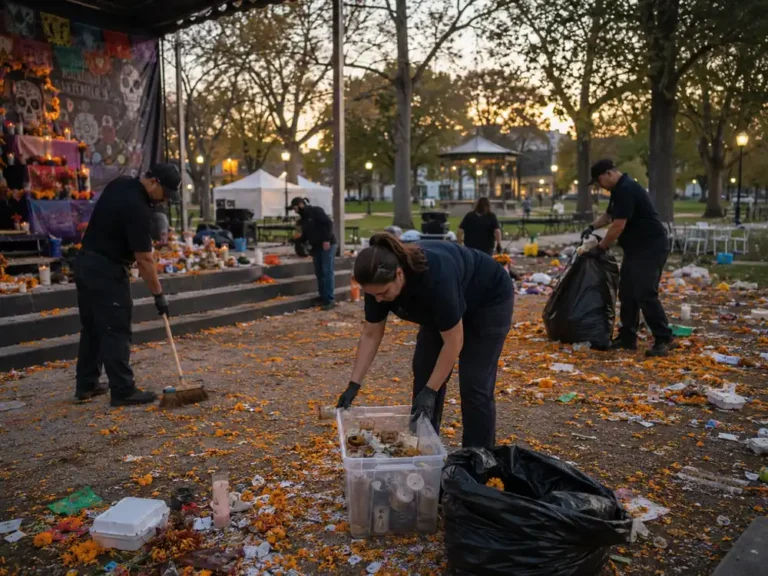
Harrison Park in East Pilsen hosts the NMMA’s annual Día de los Muertos celebration drawing 10,000+ visitors, as well as other park district-permitted community events. The outdoor footprint includes lawn areas with temporary ofrenda installations, outdoor performance stage zones, food vendor positions, and public pathways adjacent to the museum building. Post-event outdoor cleanup requires careful handling of ofrenda debris — flower petals, candle wax, food offerings, marigold garlands — and Chicago Park District restoration documentation.
Pilsen 18th Street Gallery Corridor and Arts District
The Chicago Arts District along 18th Street and South Halsted contains over 30 galleries, studios, and community art spaces. Second Fridays monthly gallery walk events and special receptions involve food and beverage service in gallery spaces where exhibited works are positioned directly adjacent to event circulation zones. Post-event gallery cleanup requires designated no-spray zones within 6 feet of exhibited works, direct-application floor cleaning near gallery walls, and non-volatile chemistry in the gallery air environment.
The Specific Risks Nobody Briefs You On Until the Venue Manager Calls in the Morning
Tin Ceiling and Stained-Glass Proximity at Thalia Hall
Thalia Hall’s original 1892 tin ceiling panels and stained-glass inlays are Chicago Landmark-designated architectural elements that cannot be replaced. Standard spray-bottle floor cleaner creates chemical mist that rises toward ceiling and wall-mounted architectural elements. The correct approach uses controlled, low-mist application methods — no spray bottles deployed in the main performance space, direct-application or mop-bucket technique only, with chemistry confirmed for original plaster and wood surfaces.
Sealed Concrete vs. Raw Concrete at Lacuna — Two Different Protocols
Lacuna’s industrial building contains both sealed and unsealed concrete floors across event spaces and corridors. Sealed concrete accepts standard neutral floor cleaner using controlled moisture. Unsealed or partially-sealed concrete absorbs beverage spill and organic residue into the surface and requires degreaser treatment, agitation, and extraction before any surface-sealing-safe cleaner is applied. We confirm surface type in each Lacuna event space before deploying any cleaning product.
Art-Adjacent Spray Chemistry at NMMA and Pilsen Gallery Spaces
The NMMA’s permanent collection includes pre-Cuauhtémoc antiquities and works spanning 3,600 years of Mexican cultural heritage. Standard commercial cleaning products become damage agents when used without surface-specific protocols in spaces containing cultural property. We designate all zones within 6 feet of gallery openings as restricted spray areas and use direct-application methods throughout.
Ofrenda Debris Handling at Harrison Park Día de los Muertos
Ofrenda installations contain marigold petals, candle wax residue, food offerings, photographs, personal mementos, and decorative elements. Post-event cleanup requires a different sequence than standard outdoor debris removal: personal mementos and photographs are collected separately, candle wax is removed without damaging park surfaces, and marigold petals are collected before wet cleaning to prevent dye transfer.
Reclaimed Material and Artist-Created Surfaces at Lacuna
Lacuna’s event spaces feature building-integrated artworks: a steampunk chandelier, shipping container entrance and bar structure, artwork displayed on walls and ceilings, and floor-mounted sculptural elements in corridor and gallery zones. We pre-confirm all fixed and semi-fixed artwork positions with venue management and designate those positions as no-contact zones during floor cleaning passes.
Mural-Adjacent Debris on 18th Street
The 16th Street Murals and building-façade murals along 18th Street are central to Pilsen’s cultural identity. Post-street-festival cleanup adjacent to mural-bearing building facades requires low-pressure debris clearing methods. Pressure washing, solvent-based degreaser runoff, or abrasive sweeping that contacts painted exterior walls can damage mural surfaces.
How We Clean a Pilsen Event — Surface Classification First, Cultural Context Always
1
Surface Inventory and Cultural Context Pre-Confirmation
Before any Pilsen cleanup begins: surface type confirmation, art-position confirmation at Lacuna and gallery spaces, and venue manager consultation on any culturally significant materials or fixed installations that require avoidance or special handling.
2
Art-Adjacent Zones — Restricted Spray Throughout
For NMMA, Lacuna, and Pilsen gallery spaces, all zones within 6 feet of exhibited artwork, gallery openings, or building-integrated artistic installations are designated restricted spray zones before cleaning begins. Direct-application, non-aerosol methods only.
3
Ofrenda and Culturally Significant Material Handling at Outdoor Events
For Harrison Park Día de los Muertos cleanup, personal mementos, photographs, and identifiable cultural objects are collected separately before general debris removal. Marigold petals and organic floral material are collected before wet treatment. Candle wax receives appropriate scraping and solvent technique before wet cleaning.
4
Historic and Industrial Surface Floor Recovery — Confirmed Protocol Per Surface
Thalia Hall main floor receives low-mist application with no spray bottles. Lacuna sealed concrete receives neutral floor cleaner with controlled moisture. Lacuna unsealed concrete receives degreaser treatment and agitation. NMMA hardwood stage receives dry debris removal first and hardwood-safe pH-neutral solution.
5
Bar and Catering Zone Priority Remediation
Dusek’s restaurant corridor, Punch House basement bar, Tack Room, and Lacuna’s Magik Street bar zone receive priority catering and bar cleanup: beverage residue treated before general floor sweep, food debris containerized, bar surfaces wiped with surface-confirmed chemistry.
6
Restroom Reset — Documented Per Unit
Every restroom is cleaned, disinfected, and restocked individually. At Thalia Hall and Lacuna multi-space events, restrooms receive a full reset, not a wipe-pass. Each unit is documented separately.
7
Outdoor Zone Clearing and Park District Documentation
For Harrison Park and 18th Street festival events, outdoor zones are cleared section by section with organics, recyclables, and general waste separated. Mural-adjacent building facades receive low-pressure clearing methods only. Chicago Park District site restoration documentation is produced before permit restoration deadline.
Why Pilsen Event Organizers Call Us Instead of a Standard Cleanup Crew
Pilsen event organizers need more than basic trash pickup after guests leave. Our team handles historic theater surfaces, industrial concrete, cultural institution protocols, mural-adjacent outdoor restoration, restroom reset, catering residue, and documented handback before morning operations.
We Distinguish Sealed from Unsealed Concrete at Lacuna
250,000 square feet of a 125-year-old industrial building contains both surface types. We confirm which is which in each event space before any product touches the floor.
Thalia Hall's Tin Ceiling and Stained-Glass Get Low-Mist Protocol
Chicago Landmark architectural elements cannot be replaced. We use no spray-bottle application in the main performance space — controlled direct-application technique only, to prevent chemical mist from reaching 1892 tin and stained-glass surfaces overhead.
NMMA and Gallery Art-Proximity Restriction Is Standard
AAM-aligned cleaning awareness means gallery openings, collection corridors, and exhibited work adjacencies are designated restricted spray zones before cleaning begins — not worked around mid-sweep.
Ofrenda Debris Is Handled With Cultural Awareness
Personal mementos, marigolds, candle wax, and food offerings at Día de los Muertos events are not treated as bulk outdoor trash. They are handled separately, in a sequence that respects the cultural significance of what they are.
Mural-Adjacent Facades Get Low-Pressure Treatment
18th Street building murals are protected public art. We keep liquid application products away from mural-bearing facades and use low-pressure clearing adjacent to painted building exteriors.
Lacuna's Artist-Created Installations Are Pre-Mapped as No-Contact Zones
Steampunk chandeliers, shipping container bars, and wall-mounted sculptural elements are not furniture. We confirm their positions with venue management before the cleanup begins.
OSHA-Aligned Chemical Handling Throughout
All products — concrete-safe cleaners, degreasers, hardwood-safe solutions, gallery-adjacent non-volatile chemistry, outdoor surface treatments — handled under OSHA Hazard Communication standards: labeled containers, current Safety Data Sheets, correct dilution ratios, PPE for all crew members.
Pilsen Event Cleaning Case Studies
Case Study 1: Thalia Hall — Private Gala, Main Performance Space and Dusek's Corridor
Client type: Corporate event director
Guest count: 240 (seated dinner configuration)
Venue footprint: Main hall (5,000 sq ft, original tin ceiling and stained-glass panels, ornate moldings), Dusek’s restaurant corridor, 2 bar service zones, restrooms
Timeline: 3.5-hour cleanup window, 9 AM venue operations opening
The problem:
A 240-person seated dinner had generated food and beverage residue on the main hall floor beneath a 1892 Chicago Landmark tin ceiling with stained-glass panel inlays. The venue manager explicitly flagged that no spray application was permitted in the main performance space due to ceiling surface sensitivity. The Dusek’s corridor had catering residue and bar spill on its floor surface. Two bar zones required restocking and wipe-down. Restrooms required full reset. 9 AM operations opening was a hard deadline.
What we did:
Main hall: zero spray-bottle application in the performance space. Direct-application technique using mop-bucket method with chemistry confirmed appropriate for the venue’s original surface. Dry debris removal first before any liquid application. No aerosol products used in the space. Dusek’s corridor cleaned with surface-confirmed chemistry and controlled moisture. Bar zones wiped with appropriate chemistry per surface type. Restrooms fully reset and individually documented. Zone photographs produced before 8:45 AM.
Outcome
No spray contact with ceiling architectural elements. No surface damage findings at 9 AM operations walkthrough. Event director received complete zone documentation before the deadline. Client name withheld for confidentiality.
Case Study 2: Lacuna Artist Lofts — Wedding Reception, Reverie Gallery and Skydeck
Client type: Private event coordinator
Guest count: 320 (Reverie Gallery reception + Skydeck cocktail)
Venue footprint: Reverie Gallery (sealed concrete floor, exposed brick walls, building-integrated artwork), Skydeck rooftop (sealed concrete deck), Magik Street bar zone, service corridors
Timeline: 4-hour cleanup window, venue operating hours next morning
The problem:
A wedding reception across the Reverie Gallery and Skydeck left food and beverage residue on sealed concrete floors in both spaces. Artist-created wall installations and a large-scale steampunk chandelier in the Reverie Gallery required cleaning crews to navigate around fixed artworks without contact. The Skydeck sealed concrete deck had beverage spill and outdoor debris from a cocktail hour with 250 guests. Gallery and studio corridor floors had foot-traffic residue from guest circulation through the building’s common areas.
What we did:
Pre-confirmed all fixed artwork positions with venue management before cleaning began. Designated those positions as no-contact zones in the cleaning plan. Reverie Gallery sealed concrete: neutral floor cleaner, controlled moisture, artwork-avoidance cleaning path. Skydeck: swept first, then neutral concrete cleaner with controlled moisture. Studio corridor floors: dry sweep and spot treatment. Magik Street bar zone: beverage residue treated before sweep, surface-confirmed bar wipe-down. Restrooms documented. Zone photographs produced.
Outcome
No artwork contact, no installation damage, no surface findings at morning operations check. Private event coordinator received documentation confirming all zones cleaned without incident. Client name withheld for confidentiality.
Case Study 3: Harrison Park Día de los Muertos — Post-Event Outdoor Cleanup
Client type: Community event coordinator (NMMA-affiliated)
Footprint: Harrison Park outdoor grounds adjacent to NMMA building, 10,000+ attendees, multiple ofrenda installation zones, outdoor stage, food vendor positions
Timeline: Same-night cleanup after 8 PM event close, Chicago Park District restoration documentation required
The problem:
The NMMA’s Día de los Muertos celebration left ofrenda debris across multiple installation zones throughout Harrison Park. Food vendor positions had organic waste and cooking residue. The outdoor stage perimeter had post-performance debris. Personal photographs and mementos mixed with general debris required careful separation. Chicago Park District site restoration documentation was required. The exterior of the NMMA building had mural elements adjacent to the event zone requiring low-pressure clearing only.
What we did:
Ofrenda zones treated first: personal photographs and mementos collected and containerized separately from general waste. Marigold petals and organic floral material collected before any wet surface treatment. Candle wax on pavement addressed with appropriate scraping followed by targeted solvent treatment. Food vendor positions cleared of organic waste and containerized separately from recyclables. Stage perimeter cleared as a separate zone. Building-adjacent areas cleared with low-pressure hand methods. Chicago Park District zone photographs produced and submitted before the next-day documentation deadline.
Outcome
All ofrenda zones cleared with cultural materials handled separately. No mural-adjacent surface damage. Chicago Park District restoration documentation accepted without dispute. Client name withheld for confidentiality.
Testimonials
★★★★★
“Thalia Hall has a 1892 tin ceiling and stained-glass panels that are Chicago Landmarks. No spray bottles in the performance space — that was the requirement. Abdullah’s team used direct-application technique throughout, confirmed the chemistry, and had documentation before 9 AM. No issues.”
Corporate Event Director | Thalia Hall, Pilsen
★★★★★
“Lacuna has artist installations throughout the venue and you have to know what’s art and what’s furniture before you start cleaning. They confirmed every fixed piece with us before the crew touched anything. Reverie Gallery came back clean with zero incidents.”
Private Event Coordinator | Lacuna Artist Lofts, Pilsen
★★★★★
“Día de los Muertos cleanup needs someone who understands what’s on the ground. The personal mementos and photos were handled separately, the candle wax was treated correctly, and the building walls were left alone. Park District documentation was in on time.”
Community Event Coordinator | Harrison Park / NMMA, Pilsen
Pilsen Event Cleaning Pricing
Pricing depends on surface type, artwork-adjacent zone count, ofrenda or cultural material handling scope, outdoor footprint, vendor density, Park District documentation requirements, festival size, and handback deadline.
Thalia Hall Historic Theater Cleanup (tin ceiling proximity, main floor, bar corridors)
Starting at $799
Lacuna Artist Lofts Industrial Space Cleanup (sealed/unsealed concrete, artwork-adjacent)
Starting at $849
National Museum of Mexican Art Event Cleanup (hardwood stage, gallery-adjacent, Courtyard)
Starting at $749
Harrison Park Outdoor Event Cleanup (ofrenda zones, food vendors, park restoration)
Starting at $899
18th Street Gallery Event or Arts District Reception Cleanup
Starting at $649
Full Multi-Space Lacuna or Pilsen Fest Multi-Venue Cleanup
Custom quote based on venue count and footprint
FAQs About Event Cleaning Services in Pilsen Chicago
Can you clean Thalia Hall after a concert or private event?
Yes. We use low-mist, no spray-bottle technique in the main performance space to protect the original 1892 tin ceiling and stained-glass panel inlays — both Chicago Landmark architectural elements. We confirm surface chemistry with venue management before beginning and produce 9 AM handback documentation.
Do you clean Lacuna Artist Lofts event spaces?
Yes. We confirm sealed vs. unsealed concrete surface type in each event space, pre-map all fixed artwork and building-integrated installation positions as no-contact zones, and clean accordingly. We handle the Reverie Gallery, La Galleria, Skydeck, and Magik Street with surface-specific protocols throughout.
Can you clean the National Museum of Mexican Art after an event?
Yes. We follow AAM-aligned cleaning protocol for gallery-adjacent spaces: restricted spray zones within 6 feet of gallery openings and collection corridors, direct-application non-aerosol methods near exhibition spaces, and hardwood stage recovery using dry-first sequence with surface-confirmed chemistry.
How do you handle ofrenda debris at Día de los Muertos events?
Personal photographs, mementos, and identifiable cultural objects are collected and containerized separately from general waste before debris removal begins. Marigold petals are collected before wet surface treatment. Candle wax is scraped and treated before any wet cleaning on the affected pavement zone. This sequence is not optional.
Do you clean 18th Street gallery event spaces?
Yes. We designate art-proximity restricted spray zones in all Pilsen gallery spaces, use direct-application methods near exhibited works, and confirm non-volatile chemistry before deploying any product in gallery-adjacent zones.
How do you protect murals on 18th Street building facades during outdoor event cleanup?
We use low-pressure hand-clearing methods adjacent to mural-bearing building facades and keep liquid application products away from painted exterior walls. No pressure-washing or high-pressure degreaser application near murals.
Do you provide Chicago Park District site restoration documentation for Harrison Park events?
Yes. We produce zone photographs and section-completion records before the permit restoration deadline for all Chicago Park District-permitted events.
How far in advance should I book for a Pilsen event?
Standard indoor venue events: 1–2 weeks. Thalia Hall, Lacuna multi-space, NMMA, or Harrison Park outdoor events with ofrenda handling and Park District documentation: 3–4 weeks minimum.
Pilsen Events Happen on Some of Chicago's Most Culturally Specific Surfaces. The Cleanup Has to Know the Difference.
A 1892 Landmark tin ceiling over a 900-person concert floor. A 125-year-old macaroni factory with 250,000 square feet of industrial loft space covered in artist-created work. The only AAM-accredited Latino museum in America. A park where 10,000 people honor their ancestors with marigold-covered altars every October.
These are not standard venue scenarios. They require surface knowledge, cultural awareness, the right chemistry, and protocol that protects what Pilsen has spent over a century building.
Call before the event ends — not after the venue manager finds out the wrong cleaner touched a 1892 tin ceiling.
✅ Thalia Hall tin ceiling proximity low-mist protocol
✅ Lacuna Artist Lofts sealed/unsealed concrete surface confirmation
✅ National Museum of Mexican Art gallery-adjacent AAM-aligned cleaning
✅ Harrison Park Día de los Muertos ofrenda debris and cultural material handling
✅ 18th Street gallery art-proximity restricted spray zones
✅ Mural-adjacent building facade low-pressure outdoor clearing
✅ Chicago Park District site restoration documentation
✅ OSHA-aligned chemical safety SOPs throughout
📍 Serving Pilsen, 18th Street Arts District, Harrison Park, National Museum of Mexican Art, Thalia Hall, Lacuna Artist Lofts, Chicago Arts District, East Pilsen gallery corridor, and adjacent Lower West Side and Heart of Chicago neighborhood event spaces