Event Cleaning Services in Andersonville Chicago

Andersonville Event Cleaning for Midsommarfest, Swedish American Museum, Back Lot Bash, Clark Street Corridor Venues, Taste of Andersonville, Historic Building Event Spaces, and Neighborhood Bar and Restaurant Events
Event Cleaning Chicago provides post-event cleaning services in Andersonville for street festival organizers, independent venue managers, museum event coordinators, chamber of commerce event directors, LGBTQ+ community event producers, neighborhood restaurant and bar operators, and private Clark Street venue owners who need same-night hardwood floor recovery, gallery-adjacent surface care, street corridor waste separation, composting-aligned organic waste handling, restroom reset, and documented site handback aligned with Andersonville’s neighborhood sustainability standards.
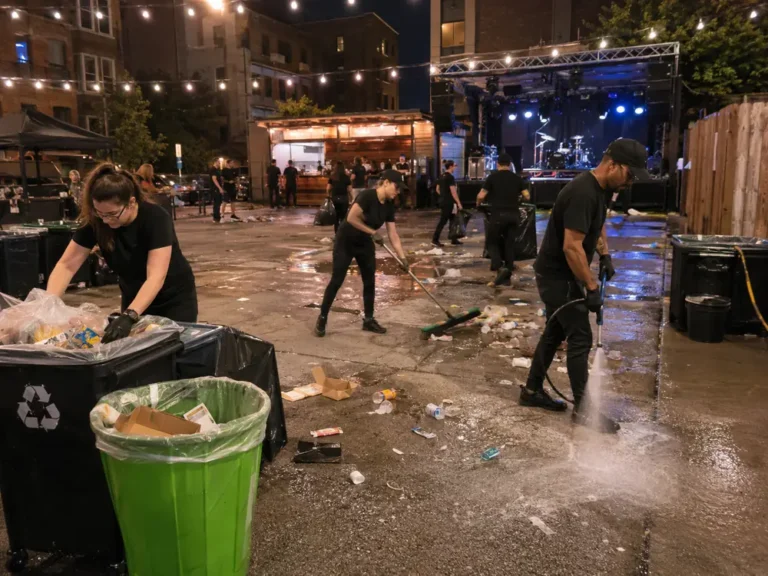
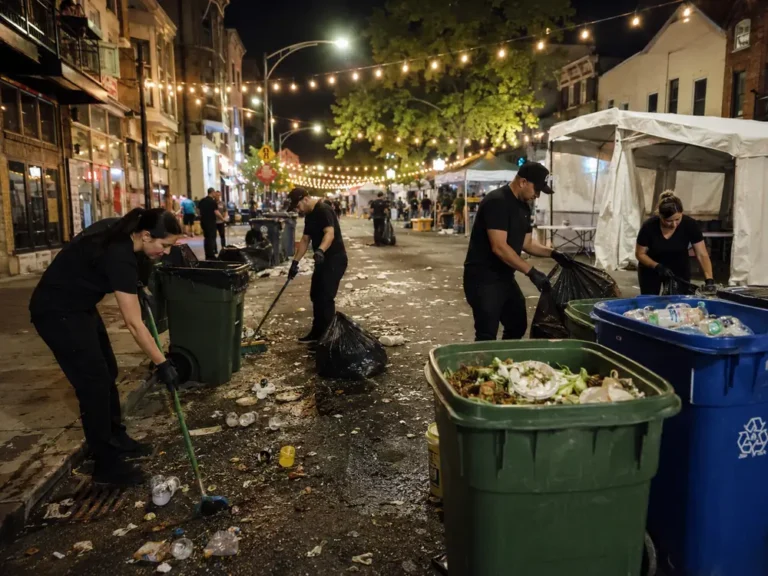
Andersonville street festival cleanup at night
★★★★★ 5.0 Rating | 100+ Chicago Events Cleaned | OSHA-Aligned Chemical Safety SOPs | Composting-Compatible Waste Separation | Bonded & Fully Insured | Historic Building and Independent Venue Cleaning | Available Festival Nights and Pride Weekend

Midsommarfest Brought 80,000 People to Six Blocks of Clark Street. The Festival Ends Friday at 10 PM. Saturday Starts at Noon. And Andersonville Expects Its Street Back — Swept, Sorted, and Composted.

That is the cleanup pressure nobody outside Andersonville fully anticipates.

Andersonville, Chicago is a neighborhood within the Edgewater community area on Chicago’s North Side, approximately nine miles north of the Loop, bordered by West Foster Avenue to the south, West Bryn Mawr Avenue to the north, North Ravenswood Avenue to the west, and North Magnolia Avenue to the east. (Wikipedia: Andersonville, Chicago) Though not one of Chicago’s official 77 community areas, Andersonville is recognized as a distinct neighborhood with its own commercial identity, civic infrastructure, and event calendar — anchored by Clark Street as the neighborhood’s primary commercial and event corridor.

That corridor carries significant historic designation. The Andersonville Commercial Historic District — running from 4800 to 5800 North Clark Street — was added to the National Register of Historic Places on March 9, 2010, under NRHP reference No. 08000294. (Wikipedia: Andersonville Commercial Historic District) The district’s brick commercial buildings, many constructed by Swedish immigrant carpenters and contractors after the Great Chicago Fire of 1871, contain the independent restaurants, bars, music venues, and event spaces that generate Andersonville’s post-event cleaning demand. According to the Andersonville Chamber of Commerce, the neighborhood is recognized as the “shop local capital of Chicago,” with a commercial district dominated by independent, locally-owned businesses — a designation that shapes the venue character and the cleanup expectations differently than a chain-restaurant corridor.

Andersonville’s event calendar is dense and distinctive. Andersonville Midsommarfest, now in its 60th year, runs June 12–14, 2026 along Clark Street from Foster Avenue to Gregory Street — three nights and two full days drawing over 80,000 attendees with multiple live music stages, food vendors, artisan booths, and Swedish cultural programming. (Andersonville Chamber of Commerce) Back Lot Bash, Chicago’s longest-running women’s outdoor Pride festival, has been held in an outdoor venue behind Cheetah Gym in the heart of Andersonville during Pride weekend since 2004, drawing over 6,000 attendees across a 4-day run. (Northalsted Business Alliance) The Taste of Andersonville in August, the Summer Sidewalk Sale in July, the Andersonville Winter Market, and the Lucia Festival of Lights in December round out a year-round event footprint that keeps Clark Street in a near-continuous event cycle from May through January.

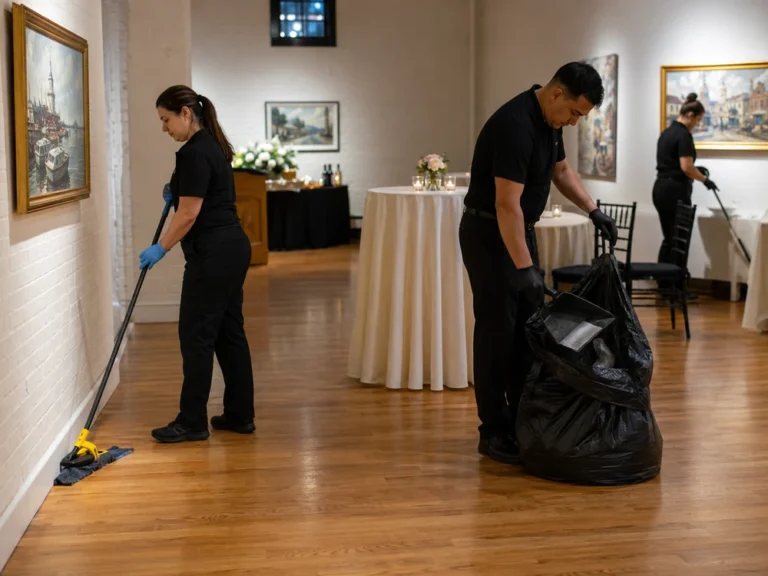
Swedish American Museum event cleaning crew

The defining feature of Andersonville’s event cleaning problem is not just scale — it is the neighborhood’s sustainability infrastructure and the expectation that post-event cleanup matches it.

Andersonville is not a typical Chicago neighborhood when it comes to waste. The eco-Andersonville program, launched in 2013, was the first Chicago neighborhood-wide residential composting initiative. The Clark Street Composts program, a partnership between the Andersonville Chamber of Commerce and WasteNot Compost, launched in September 2021 with 22 participating Clark Street businesses committing to diverting compostable waste from landfills. In the first six weeks alone, 13,150 pounds of waste were diverted. By the program’s end, over 120,000 pounds of total waste had been diverted — equivalent to 81,840 pounds of CO2 emissions. (WasteNot Compost: Clark Street Composts) Time Out Chicago, which ranked Andersonville the second-coolest neighborhood in the world in 2021, specifically cited the Clark Street Composts program as one of the neighborhood’s distinguishing forward-looking initiatives. This matters for post-event cleanup because Midsommarfest and other Andersonville events increasingly operate within a neighborhood culture that treats source separation — organics, recyclables, general waste — not as optional, but as baseline conduct for any vendor or service provider operating on Clark Street.

The DCASE Special Events Resource Guide requirement that event organizers are responsible for site cleaning throughout the permit period applies here as it does citywide. But in Andersonville specifically, that requirement lands within a community that has documented composting diversion targets, active Chamber of Commerce oversight of Clark Street restoration, and business neighbors who notice when the corridor isn’t returned to standard. That combination — civic infrastructure plus independent business community oversight plus sustainability expectation — makes Andersonville post-event cleanup more accountable than most Chicago street corridors.

The sections below cover every Andersonville event zone: the Clark Street festival footprint, the Swedish American Museum gallery hardwood floor, the independent bar and restaurant venues of the National Historic District, the Back Lot Bash outdoor lot, and the smaller neighborhood event spaces that fill year-round. Each one has a distinct surface type, waste profile, and community standard that determines how the cleanup gets done.

Andersonville's Event Landscape — What's Actually Being Cleaned

Andersonville Midsommarfest — Clark Street Festival Corridor (Foster Ave. to Gregory St.)

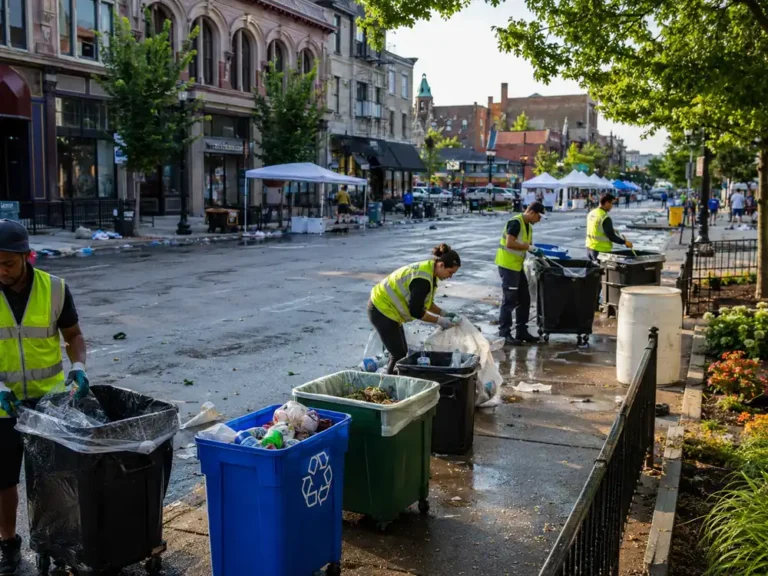
Midsommarfest, Chicago’s longest-running Swedish-heritage summer festival, transforms approximately six blocks of Clark Street into a multi-stage, multi-vendor outdoor event zone drawing over 80,000 attendees across a Friday evening and two full weekend days. The festival includes multiple live music stages, food vendors with cooking equipment, artisan vendor booths, and community organization tents. The Clark Street asphalt corridor, sidewalks, and adjacent cross-streets absorb the full waste footprint — food packaging, beverage cups, vendor cooking residue, and organic food waste — across an event that runs late into the evening on consecutive days. The Andersonville Chamber of Commerce’s composting infrastructure and the eco-Andersonville framework mean post-festival waste handling is observed by the neighborhood business community, not just permitted officials.

Swedish American Museum (5211 N. Clark St.)

The Swedish American Museum, founded in 1976 following a dedication ceremony attended by King Carl XVI Gustav of Sweden, hosts private events for up to 200 guests (seated capacity 125) in its gallery space featuring polished hardwood floors, white brick walls, track lighting, and Swedish folk art and contemporary design exhibits surrounding the event space. (Tagvenue: Swedish American Museum) The museum has hosted weddings, banquets, awards ceremonies, and music performances. Its polished hardwood floors and gallery-adjacent artwork require the same art-proximity surface protocol and hardwood-safe chemistry sequence used in River North gallery spaces — grit removal before wet treatment, no solvent-based product near the gallery exhibits, and controlled moisture on the hardwood to prevent grain raise and finish damage.

Back Lot Bash Outdoor Venue (Behind Cheetah Gym, N. Clark St.)

Back Lot Bash, founded in 2004 by Amie Klujian and Christina Wiesmore-Roberts, draws over 6,000 attendees across 4 days to an outdoor lot venue in the heart of Andersonville during Chicago Pride weekend. The outdoor lot surface — sealed concrete or asphalt — accumulates 4 days of beverage cups, food packaging, bar service residue, and stage perimeter debris. This is a compact, high-density venue footprint rather than a street-length corridor; the cleanup is concentrated, but the organic waste and beverage density per square foot is higher than a comparably-sized street festival zone.

Clark Street Independent Bar and Restaurant Venues

Andersonville’s National Historic District Clark Street corridor contains dozens of independent bars, restaurants, and event spaces — including Hopleaf Bar, Hamburger Mary’s, Nobody’s Darling, Spiteful Brewing, and the Kit Kat Lounge & Supper Club — many housed in the original late-19th-century brick commercial buildings. These buildings feature hardwood floors, exposed brick walls, original woodwork, and back-of-house configurations that differ from modern commercial construction. Post-event cleanup in these spaces requires surface-confirmed chemistry for historic hardwood and brick, bar-area grease treatment appropriate for the building’s floor type, and building-access coordination with independent owner-operators who are often on-site during and after events.

Andersonville Galleria and Independent Performance Spaces

The Andersonville Galleria at 5247 N. Clark — a year-round art marketplace featuring over 100 independent artists across two levels — hosts special events, exhibitions, and community gatherings. Its multi-level format and mixed surface types (polished concrete, wood, and sealed gallery floors) require zone-specific cleaning sequences. The pH Comedy Theater, Neo-Futurist Theater, Steep Theater, and Mayne Stage add intimate performance venue cleanup to the neighborhood scope — post-show restroom resets, lobby floor recovery, and bar-area remediation within historic building envelopes.

The Risks Specific to Andersonville — What Goes Wrong When a Cleanup Crew Doesn't Know the Neighborhood

Ignoring the Composting Infrastructure

Andersonville’s Clark Street Composts program diverted over 120,000 pounds of waste in a single pilot run. The neighborhood’s composting culture is not aspirational — it is operational, with participating businesses actively separating organic waste. A post-festival cleanup crew that consolidates all Midsommarfest waste into a single undifferentiated stream is not just making a cleanup decision. They are violating the waste handling standard that the Andersonville Chamber of Commerce built its Clark Street Composts infrastructure around. We separate organic waste, recyclables, and general waste in parallel — not as an add-on, but as the default sequence.

Beer and Beverage Residue on Historic Hardwood Floors

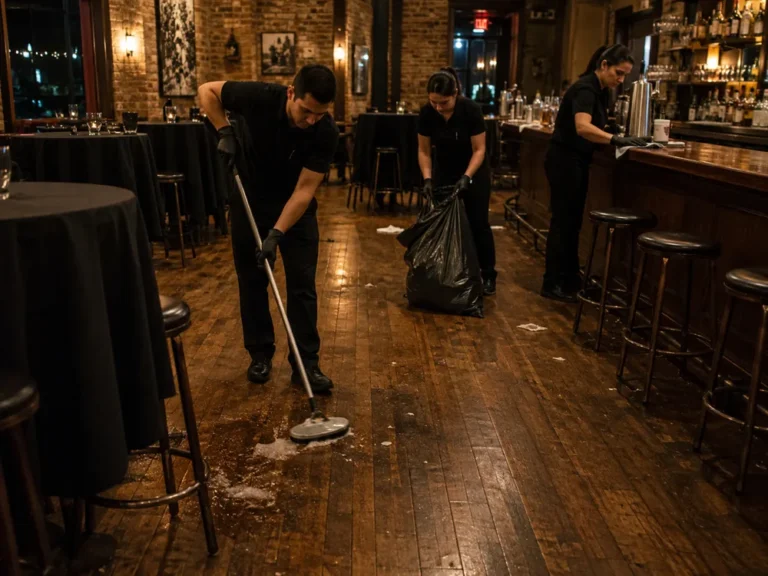
Clark Street’s late-19th-century commercial buildings have hardwood floors that have survived 125-plus years of Chicago winters, neighborhood transitions, and continuous commercial use. Post-event beverage residue — beer spill, cocktail overpour, mixer drip — left on unsanded or lightly-finished historic hardwood overnight causes three problems: sugar-based sticky film that attracts debris, progressive finish breakdown at the penetration zone, and wood fiber swelling if wet-mopped without prior dry treatment. The correct sequence for post-event hardwood recovery in an Andersonville bar: dry debris removal, absorbent treatment of wet residue zones, hardwood-safe neutral cleaning solution with controlled low-moisture application. The wrong sequence — wet mop first — accelerates every one of those problems.

Gallery Exhibit Proximity at the Swedish American Museum

The Swedish American Museum’s gallery floor is a polished hardwood surface surrounded by oil paintings, folk art, and contemporary Swedish design on display throughout the event space. Post-event cleanup cannot include spray application of floor cleaner near gallery walls — the same restriction that applies in River North gallery spaces. We designate art-proximity zones within 6 feet of exhibited works as restricted spray zones, use direct-application methods for floor cleaning near gallery walls, and confirm with museum staff on any exhibited piece proximity before deploying any product.

Multi-Day Festival Grease Accumulation on Clark Street Asphalt

Midsommarfest runs three days. Food vendors with cooking equipment — grills, fryers, steam tables — operate across multiple booth positions along the Clark Street corridor on consecutive days. By Sunday evening, cooking grease has migrated from vendor booth footprints onto adjacent asphalt sections and sidewalk joints across multiple blocks. Standard street sweeping does not remove embedded cooking grease from asphalt. It requires targeted degreaser application to the cooking-adjacent asphalt sections before any broad corridor sweep — the same protocol used for Northalsted Market Days vendor zone cleanup, applied to a six-block historic district corridor.

Sustainable Business Neighbor Accountability

Unlike a generic Chicago street corridor, Clark Street’s independent business operators are engaged civic stakeholders. The Andersonville Chamber of Commerce actively monitors neighborhood cleanliness and coordinates with the DCASE permit framework. A post-festival corridor that still has organic waste at 9 AM Sunday — when Midsommarfest Saturday programming ends at 10 PM and Sunday programming opens at noon — generates documented complaints from business neighbors, not just city inspectors. The cleanup window between the end of Saturday and the start of Sunday is operationally real, not theoretical.

How We Clean an Andersonville Event — Sustainability First, Surface Second

1

Step 1: Event Type and Waste Stream Pre-Planning

Before any Andersonville cleanup begins, we confirm the event’s waste profile: food vendor count, cooking equipment types (grease-generating vs. non-grease), beverage service volume, organic waste expected volume, recyclables, and general waste. For Midsommarfest and other multi-day events, we plan waste stream separation stations in advance — organics, recyclables, general — aligned with the Clark Street Composts composting framework.
2

Step 2: Organic Waste Priority — Separated Before General Sweep

Food waste, cooking residue, and organic material are collected and containerized separately before the main corridor or venue sweep begins. In a neighborhood with active composting infrastructure, organic waste mixed into general trash is a diversion failure. We containerize organics first, hand them off to composting-aligned disposal where the event plan includes this, and then proceed with the general cleanup sequence.
3

Step 3: Grease-Zone Treatment on Festival Asphalt — Before Sweeping

Food vendor booth positions along Clark Street are identified before the sweep begins. Cooking grease-adjacent asphalt zones receive targeted degreaser treatment before any sweeping — this is the only method that prevents grease residue from being spread across adjacent corridor sections by a sweeper. Each vendor position is treated and cleared before the linear sweep covers that section.
4

Step 4: Historic Hardwood Floor Recovery — Dry Treatment First

For Swedish American Museum events, Clark Street bar venues, and other historic building event spaces, the floor recovery sequence is fixed: dry debris and particulate removal first, absorbent treatment of wet beverage residue zones, hardwood-safe pH-neutral cleaning solution with controlled low-moisture application. No wet mop on a beer-saturated historic hardwood floor without prior dry treatment. No solvent-based product on original finish hardwood.
5

Step 5: Gallery Art Proximity Protocol at Swedish American Museum

All zones within 6 feet of exhibited artwork at the Swedish American Museum are treated as restricted spray zones. Direct-application non-aerosol methods only in art-proximity areas. Chemistry confirmed non-volatile and appropriate for gallery air environment before deployment. Museum staff consulted on any proximity concerns before floor cleaning begins in the gallery.
6

Step 6: Restroom Recovery — Documented Per Unit

Every restroom is cleaned, disinfected, and restocked individually. In multi-day festival venues and late-night Clark Street bars, restrooms accumulate saturation levels that require a full reset sequence — not a quick wipe. Each restroom unit is documented as a separate completion record.

Why Andersonville Event Organizers Call Us Instead of a Generic Cleanup Crew

Back Lot Bash outdoor event cleanup

We Understand Andersonville's Composting Culture

The Clark Street Composts program diverted over 120,000 pounds of waste in a single pilot. We separate organics, recyclables, and general waste as the default sequence — not an add-on. This aligns with the eco-Andersonville framework that Clark Street businesses and the Chamber of Commerce actively uphold.

Historic Hardwood Floors Get the Right Sequence

Late-19th-century commercial building hardwood floors require dry treatment before wet application. We do not wet-mop beer-saturated historic wood. We remove residue, treat with absorbent methods, then apply hardwood-safe chemistry with controlled moisture.

Swedish American Museum Gallery Protocol Is Built In

Polished hardwood floors adjacent to Swedish folk art and oil paintings require art-proximity restricted spray zones. We designate those zones before cleanup begins and use direct-application methods near exhibited works.

Midsommarfest Scale Requires Zone Teams, Not a Single Crew

Six blocks of Clark Street with 80,000 attendees, multiple food vendor positions, multi-day grease accumulation, and a between-day cleanup window requires parallel zone teams — not a linear single-crew sweep that takes until 4 AM.

Cooking Grease on Clark Street Asphalt Gets Treated Before Sweeping

Vendor booth grease positions are identified and treated with degreaser before the corridor sweep begins. This is the only way to prevent cooking grease from being redistributed across adjacent asphalt by the sweep motion.

The Between-Day Cleanup Window Is a Real Operational Deadline

Midsommarfest Saturday ends at 10 PM and Sunday starts at noon. That 14-hour window is the cleanup window for the full Saturday footprint. We scope and staff to complete within that window — not to arrive at the start of it.

OSHA-Aligned Chemical Handling Throughout

All products — hardwood-safe cleaners, degreasers, disinfectants, organic-waste handling solutions — are managed under OSHA Hazard Communication standards: labeled containers, current Safety Data Sheets, correct dilution ratios, PPE for every crew member.

Andersonville Event Cleaning Case Studies

Historic Andersonville bar floor cleaning

Case Study 1: Andersonville Midsommarfest — Saturday Night Corridor Cleanup Between Festival Days

Client type: Festival operations coordinator Footprint: Approximately 6 blocks of N. Clark Street, Foster to Gregory; 4 performance stages; 80+ vendor positions Timeline: Saturday close at 10 PM to Sunday open at noon — 14-hour window Waste profile: Food vendor organic waste, cooking grease at multiple vendor positions, beverage cups, artisan vendor packaging, stage perimeter debris

The problem:

The full Saturday Midsommarfest footprint — 80+ vendor positions across six blocks, four stages, and thousands of attendees — had to be cleared, composted where applicable, and documented before Sunday noon programming. Cooking grease from food vendors had migrated from booth positions onto adjacent Clark Street asphalt sections. The Andersonville Chamber of Commerce expected the corridor restored to a standard consistent with the Clark Street Composts program’s waste separation ethos.

What we did:

Divided the six-block corridor into 8 linear sections with parallel teams. Identified all cooking-vendor positions first; those asphalt zones received degreaser treatment before any sweeping began. Organic food waste collected and containerized separately across all vendor positions. Recyclables separated from general waste throughout. Stage perimeter zones cleared as independent work units. Section-by-section photographs produced. Full corridor cleared and documented before 10 AM Sunday — two hours before noon opening.

Outcome

Full corridor cleared within the between-day window. Organic waste separated for composting-aligned disposal. Andersonville Chamber of Commerce received section documentation. Sunday programming opened on schedule with a clean corridor. Client name withheld for confidentiality.

Case Study 2: Swedish American Museum — Wedding Reception, Gallery Floor and Museum Spaces

Client type: Private event coordinator (acting for couple) Guest count: 140 Venue footprint: Main gallery (polished hardwood floor, gallery exhibits on all walls), kitchen rear area, coat-check room, restrooms Timeline: 3-hour cleanup window, 9 AM museum opening

The problem:

140 wedding guests across an evening reception had generated food and beverage residue on the polished hardwood gallery floor adjacent to exhibited Swedish folk art and contemporary design pieces. Beer and wine spill in the dancing area had saturated the hardwood floor surface near the center of the gallery. Cleaning near gallery walls required art-proximity protocol — no spray application within 6 feet of exhibited works. The museum opened at 9 AM.

What we did:

Gallery floor: dry debris removal first across the full hardwood surface. Art-proximity zones (6 feet from gallery walls with exhibited pieces) designated as restricted spray areas. Wet residue in the dancing zone treated with absorbent application before any hardwood cleaner was deployed. Hardwood-safe pH-neutral solution applied with controlled low-moisture damp mopping — no standing water, immediate dry-follow. Direct-application non-aerosol method used near gallery wall zones. Kitchen rear area and coat-check room cleared. Restrooms fully reset and documented. Zone photographs produced before 8:45 AM.

Outcome

Museum opened on schedule. Gallery hardwood floor showed no raised grain, no tacky residue, no finish damage. No post-event art proximity incident. Event coordinator received documentation before 9 AM opening. Client name withheld for confidentiality.

Case Study 3: Back Lot Bash — Post-Festival Outdoor Lot Cleanup

Client type: Festival production manager Footprint: Outdoor concrete/asphalt lot behind Cheetah Gym, approximately 8,000 sq ft; 1 main stage; bar service stations; vendor zone Event type: 4-day outdoor Pride festival, single-day final-day cleanup Timeline: Same-night cleanup after final day close

The problem:

The final day of a 4-day outdoor festival left accumulated beverage cups, food packaging, bar service residue, and stage perimeter debris across 8,000 sq ft of compact outdoor lot surface. Four days of outdoor bar service had left concentrated beverage residue on sealed concrete in the bar station zones. The density of waste per square foot was higher than a street corridor festival due to the contained venue footprint and multi-day accumulation.

What we did:

Bar station zones treated as first priority: beverage residue concentrated in sealed concrete bar zones treated with appropriate concrete-safe degreaser before general sweep. Stage perimeter cleared as a dedicated zone. Beverage cups, food packaging, and general waste collected in parallel sections. Recyclables and organic waste separated from general waste. Sealed concrete surface swept and spot-cleaned after degreaser treatment. Zone photographs produced. Full lot cleared within same-night window.

Outcome

Outdoor lot cleared and documented within the same-night window. Bar service residue removed from concrete surfaces without surface damage. Festival production manager received handback documentation. Client name withheld for confidentiality.

Testimonials

★★★★★
“Midsommarfest has a 14-hour window between Saturday and Sunday. Abdullah’s crew worked in sections, treated the grease vendor zones first, separated the composting waste, and had the full corridor documented before 10 AM Sunday. That’s exactly what we need from a cleanup partner in this neighborhood.” Festival Operations Coordinator | Andersonville Midsommarfest
★★★★★
“The Swedish American Museum has polished hardwood floors and art on every wall. They understood the art-proximity restriction, treated the beer spill correctly before mopping, and had documentation before our 9 AM opening. No damage, no issues.” Private Event Coordinator | Swedish American Museum, Andersonville
★★★★★
“Back Lot Bash is a 4-day festival in a compact lot. The concrete bar zones were saturated. Abdullah’s team treated those first, separated the recyclables and organics, and cleared the lot same-night. Professional and thorough.” Festival Production Manager | Back Lot Bash, Andersonville

Andersonville Event Cleaning Pricing

Pricing depends on surface type, vendor count, cooking grease zones, organic waste volume, composting separation scope, outdoor footprint, between-day timing requirements, DCASE documentation needs, and handback deadline.
Andersonville corridor waste sorting cleanup

Clark Street Historic Venue Indoor Cleanup (hardwood floor, brick, bar area) — up to 3,500 sq ft

Starting at $699

Swedish American Museum Gallery Event Cleanup (polished hardwood, art-adjacent)

Starting at $749

Outdoor Festival Lot Cleanup — Back Lot Bash scale, up to 10,000 sq ft

Starting at $849

Midsommarfest Corridor Cleanup — per block section, composting-separated

Starting at $649 per block section

Full Midsommarfest Between-Day Corridor Cleanup (6 blocks, full waste separation)

Custom quote based on vendor count, stage zones, and composting scope

Taste of Andersonville or Summer Sidewalk Sale Post-Event Cleanup

Starting at $599 per zone section

FAQs About Event Cleaning Services in Andersonville Chicago
Yes. We handle the full Clark Street corridor cleanup between Saturday close at 10 PM and Sunday noon opening — zone teams working parallel sections, organic waste separated for composting-aligned disposal, cooking grease zones treated before sweeping, and DCASE corridor documentation produced before Sunday programming opens.

Yes. Consistent with the Clark Street Composts program and eco-Andersonville’s composting infrastructure, we separate organic food waste, recyclables, and general waste as the default sequence for all Andersonville event cleanups — not as an optional add-on.

Yes. We use polished hardwood floor protocol (dry treatment before wet application, hardwood-safe pH-neutral chemistry, controlled moisture) and art-proximity restricted spray zones for the gallery floor cleaning. We produce 9 AM handback documentation for museum opening.

We identify all cooking-vendor booth positions before any sweeping begins and apply asphalt-appropriate degreaser to those sections first. Sweeping over unaddressed grease spreads it across adjacent asphalt. Grease treatment before sweeping is the only correct sequence.

Yes. We handle the outdoor lot including bar service residue zones, stage perimeter, vendor positions, and full waste stream separation — same-night, within the post-festival window.

Yes. Organic waste separation is standard in our Andersonville cleanup sequence, consistent with the neighborhood’s active composting infrastructure and the eco-Andersonville framework.

Standard indoor venue events: 1–2 weeks. Midsommarfest between-day corridor cleanup, Back Lot Bash, or multi-day festival events requiring composting coordination: 3–4 weeks minimum.

Andersonville Expects More Than Clean. It Expects Sorted, Composted, and Documented.

Six blocks of National Historic District asphalt with cooking grease from 80 vendors. A 1976 Swedish museum with polished hardwood floors and oil paintings on every wall. A 4-day outdoor Pride festival in a compact lot. Fourteen hours between Saturday and Sunday to restore an entire festival corridor.

Andersonville’s events are shaped by its identity — a Swedish-heritage, LGBTQ+-welcoming, sustainability-committed neighborhood that has been building its own waste infrastructure since 2013. Its cleanup standards reflect that identity. The crew that shows up with garbage bags and skips the composting separation does not meet this neighborhood’s standard.

Call before the festival ends — not after the Chamber of Commerce calls about the corridor.

✅ Midsommarfest Clark Street corridor cleanup with between-day window

✅ Organic waste separation aligned with Clark Street Composts program

✅ Swedish American Museum polished hardwood and gallery art-proximity protocol

✅ Back Lot Bash outdoor lot and bar service zone cleanup

✅ Cooking grease treatment on historic district asphalt before sweeping

✅ DCASE permit restoration documentation produced on deadline

✅ Hardwood-safe chemistry and art-proximity restricted spray zones

✅ OSHA-aligned chemical safety SOPs throughout
📍 Serving Andersonville, Clark Street National Historic District, Foster Avenue corridor, Swedish American Museum, Back Lot Bash venue, Winnemac Park area events, Berwyn station corridor, and adjacent Edgewater and Uptown neighborhood event spaces

Reviews