- 100% SATISFACTION GUARANTEED
- 24/7/365 RESPONSE
- WE WORK WITH ALL INSURANCES
Event Cleaning Chicago handles post-event cleanup in Greektown for restaurant private dining event managers, street festival organizers, cultural venue coordinators, bar and grill event staff, and Halsted Street corridor operators — covering restaurant private room tile and hardwood floor remediation, Greek cuisine cooking residue treatment, olive oil and saganaki grease removal from dining surfaces, outdoor Halsted Street festival asphalt degreasing, National Hellenic Museum event space cleanup, and handback documentation before your next morning's lunch service or festival permit deadline.
★★★★★ Insured Event Cleaning Team — Verified service details available before booking
🕒 24/7/365 Response — Available Late Dinner Nights, Festival Weekends, and Private Event Dates
Greek cuisine leaves a different residue profile than standard American bar food. Olive oil, saganaki (flaming cheese), lamb grease, and tzatziki-based sauces all behave differently on tile and hardwood floors than beer spill and burger debris. If your cleaning crew does not know that difference, they will wet-mop olive oil residue across your dining room floor and spread it instead of removing it.
The Neighborhood and Its Event Footprint
Greektown is a dining, nightlife, and cultural district on Chicago’s Near West Side, located along Halsted Street between Van Buren Street and Madison Street — roughly five blocks, immediately west of the Loop. The district has been the center of Chicago’s Greek restaurant scene for over 60 years. Greek Islands at 200 S. Halsted has been open since 1971. Athena Restaurant, 9 Muses Bar and Grill, Spectrum Bar and Grill, and Zeus Restaurant are family-run operations that have been on Halsted for 25 to 40 years, as noted in Greek Reporter’s feature on Chicago Greektown. Approximately 150,000 people of Greek ancestry live in the greater Chicago area — and a significant portion of them use Greektown restaurants for private family celebrations, community events, and cultural gatherings throughout the year.
The Taste of Greektown festival — now in its 35th year — runs annually along Halsted Street from Adams to Van Buren, Friday through Sunday in late August, with live music, Greek dancing, and food from every Halsted Street restaurant. That three-day festival leaves a specific outdoor residue problem: cooking grease from Greek food preparation migrates differently on Halsted asphalt than standard festival cooking oil. Lamb fat and olive oil have higher viscosity at ambient temperature than vegetable oil — they do not sweep off asphalt. They get pressed deeper into the surface by foot traffic.
Here is what most cleaning crews miss: olive oil and lamb grease on a tile floor do not look the same as beer spill. Beer spill is visible. Olive oil creates a thin, nearly invisible slick film on tile that makes the floor slippery within minutes of the first guest walking across it. A post-event cleanup crew that wet-mops an olive oil residue zone without prior dry treatment spreads the film across a wider floor area — making the slip hazard larger, not smaller.
The Illinois Department of Public Health enforces food service sanitation standards under 77 Ill. Adm. Code 750 for every food-licensed restaurant in Greektown. A floor with oil residue that was not properly treated after a private dining event is a sanitation violation at the morning inspection — not just a safety risk.
The Illinois Environmental Protection Agency’s solid waste management requirements apply to the organic food waste generated at Greektown’s street festival — lamb bones, bread, olive debris, and packaging from 35 years of annual food service on Halsted. Organic food waste separation is required — not optional — for festival events on public streets under DCASE Special Event Permit framework.
Our chemical handling follows OSHA 29 CFR 1910.1200 on every job — Safety Data Sheets current, containers labeled, crew trained before any product enters a restaurant or festival space.
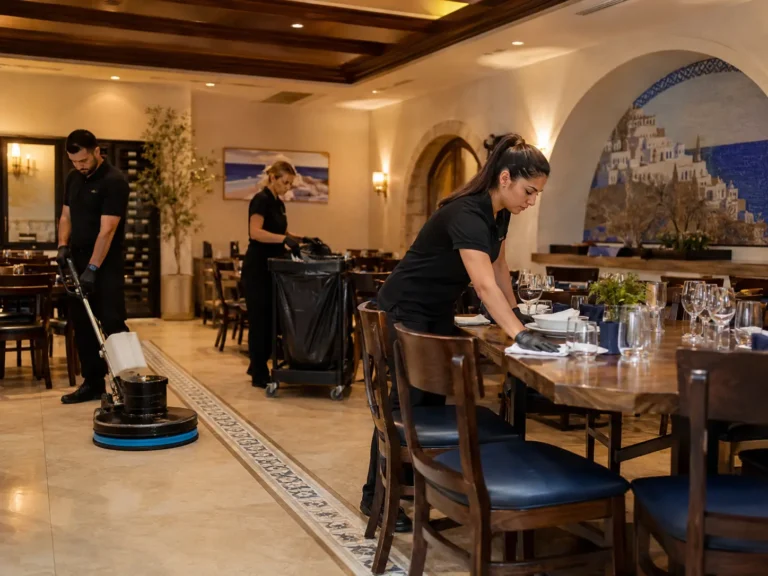
Private dining events at Greek Islands, Athena, 9 Muses, and Spectrum generate a specific residue combination: olive oil from dipping and cooking, saganaki grease from flamed cheese service, lamb fat from roasted meat platters, and tzatziki-based sauce spill from shared mezze plates. All of these require dry absorption treatment before any wet floor application. Wet mopping over olive oil or lamb fat without prior dry treatment spreads the residue and creates an invisible slip hazard on tile. We apply dry absorbent treatment to oil and grease residue zones first — then follow with appropriate food-safe pH-neutral floor chemistry. Dining room tile and hardwood sections confirmed clean and slip-safe before next morning's service.
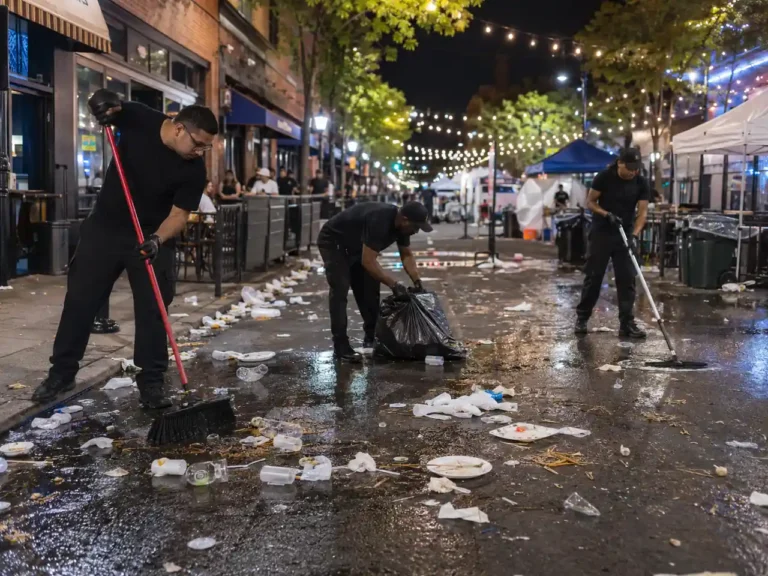
Three days of Greek food service on Halsted Street between Adams and Van Buren leaves lamb grease and olive oil in the asphalt surface at cooking station zones. Standard sweeping over high-viscosity cooking grease on asphalt pushes it deeper into the surface and spreads it outward with foot traffic. We apply surface degreaser to cooking-adjacent asphalt zones at low pressure before any mechanical sweep begins. Organic food waste — lamb bones, bread, produce scraps, packaging — separated from recyclables and general waste at every vendor position. DCASE Special Event Permit and Chicago Park District site restoration documentation produced before the deadline.
The National Hellenic Museum at 333 S. Halsted Street hosts private events, cultural receptions, fundraiser dinners, and community gatherings in its event spaces adjacent to permanent collection exhibits and cultural artifact displays. Museum-adjacent cleaning requires non-aerosol, low-VOC chemistry — consistent with the American Alliance of Museums’ collections care guidance for gallery-adjacent event spaces. (AAM: Collections Stewardship — We designate all National Hellenic Museum event spaces as no-spray zones — direct-application technique throughout.
Bar and grill spaces on Halsted — 9 Muses, Spectrum, Zeus — generate post-event cleanup across sealed concrete and tile bar floors with Greek food residue, beer and cocktail spill, and outdoor-tracked particulate from Halsted foot traffic. Bar mat zones removed and treated separately from the floor beneath. Bar-adjacent floor sections treated as priority zones before full floor sweep.
The annual Greek Independence Day parade along Halsted Street generates street surface debris, food vendor residue, and crowd-related packaging waste across the full parade corridor. Post-parade cleanup covers surface degreasing at food vendor positions, organic waste separation, packaging removal, and DCASE permit documentation before the next morning's street reopening.
Private family celebrations, community gatherings, and corporate events in Greektown restaurant private rooms generate catering residue specific to Greek cuisine — mezze spreads, roasted meat platters, shared dips, and flambéed dishes. Every catering zone gets priority treatment before the dining room floor sweep. Catering surface residue cleared from tables and service stations before floor work begins.
Every restroom fixture disinfected, floor cleaned, supplies restocked, and condition photographed before handback. Documentation delivered before next morning's lunch service opening, festival permit deadline, or museum operating hours.
Your private dining room hosted 80 guests for a Greek family celebration with mezze, saganaki, and lamb. The kitchen closes at 11 PM. Lunch service starts at 11:30 AM. The tile floor has olive oil film and lamb grease from three hours of shared plate service — and it needs dry treatment before wet mopping, or it will be a slip hazard for your morning staff. We know the correct sequence for Greek cuisine residue. We apply it every time.
You run a three-day street festival on Halsted with 10-plus restaurant vendors cooking Greek food on public asphalt. By Sunday evening, the cooking grease from lamb and olive oil is in the asphalt surface at every cooking station. DCASE permit restoration is required before the street reopens Monday morning. We handle the degreaser protocol, organic waste separation, and documentation before your deadline.
Your fundraiser dinner or cultural reception used the museum's event space with permanent collection exhibits and artifacts in proximity. No spray products near cultural artifacts. Direct-application technique throughout. Low-VOC chemistry documented. Handback before museum operating hours.
Your private buyout or watch party left bar mat zones soaked in Greek cocktails and food residue. Mats come off first. Floor beneath gets cleaned. Mats get treated separately. Both confirmed clean before the next day's service.
Greek community gatherings, church event receptions, cultural celebrations, and nonprofit dinners at Greektown venues all need the same catering zone treatment, Greek cuisine residue protocol, and handback documentation — sized to the actual event footprint and timed to the venue's next operating deadline.
We clean events across the full Greektown corridor and adjacent Near West Side neighborhoods:
Halsted Street — Van Buren Street to Madison Street (full Greektown corridor)
Greek Islands Restaurant — 200 S. Halsted St.
Athena Restaurant — 212 S. Halsted St.
9 Muses Bar and Grill — 315 S. Halsted St.
Spectrum Bar and Grill — 233 S. Halsted St.
Zeus Restaurant — 226 S. Halsted St.
National Hellenic Museum — 333 S. Halsted St.
Adams Street corridor — Festival footprint southern boundary
Van Buren Street — Festival and event spaces
Madison Street — Northern Greektown boundary venues
Near West Side adjacent event spaces — West Loop, Little Italy, University Village
Adjacent neighborhoods served: West Loop, Near West Side, River North, South Loop, Pilsen, Little Italy
Every Greektown venue we serve is within our standard Chicago service zone — no travel surcharge applied.
Greektown restaurants run late. Private dining events on Halsted Street often finish at 11 PM or midnight. Lunch service the next morning starts at 11:30 AM or noon. That gap is enough time — but only if the cleanup crew arrives quickly, works correctly, and does not have to redo a floor that got wet-mopped over olive oil residue without dry treatment first.
We deploy same-night after private dining events, festival closes, and cultural event cleanups across all Greektown venues. Same-day bookings accepted based on crew availability. For Taste of Greektown festival weekend and Greek Independence Day parade cleanup, book 3 to 4 weeks in advance — festival dates fill quickly.
Starting at $499
Starting at $699
Starting at $549
Starting at $649
Starting at $799 per section
Custom quote based on footprint
Starting at $849
Call for contract rate
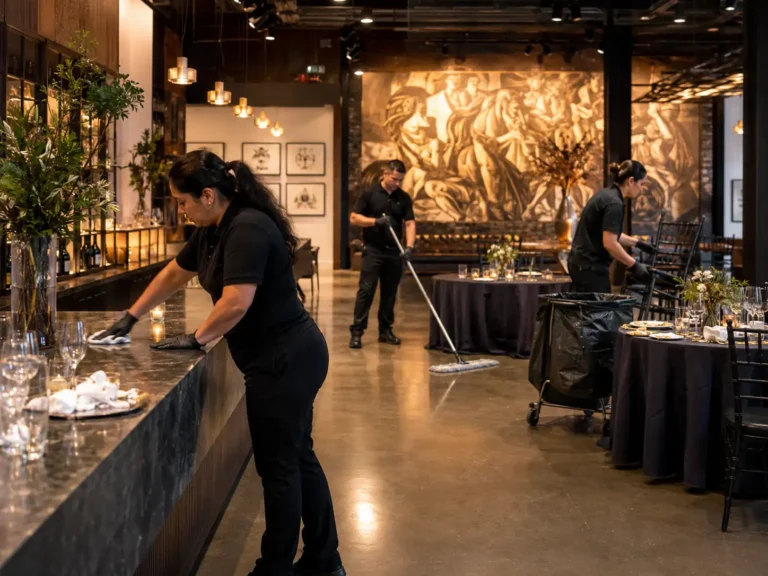
Olive oil on tile creates an invisible slip hazard. Wet mopping over it spreads the film wider. Dry absorbent treatment goes on first — every time, on every Greektown tile floor job. Then the wet application follows. That sequence removes the hazard instead of relocating it.
High-viscosity cooking residue from Greek cuisine does not behave like standard bar spill on a floor. It does not evaporate. It does not dry in a way that makes it easier to sweep. It gets more adhesive as it cools. Dry treatment first — then pH-neutral food-safe floor chemistry. Every private dining room job in Greektown follows this sequence.
Lamb fat and olive oil on Halsted asphalt during Taste of Greektown have higher viscosity than standard vegetable oil. They do not sweep off the surface — they get pressed deeper with foot traffic. Low-pressure degreaser on cooking-adjacent zones before any sweep. That is the only method that actually removes the grease.
Cultural artifacts and permanent exhibits are in proximity to every event space at the museum. No aerosol or spray-bottle application anywhere in the building. Direct-application technique, low-VOC chemistry, documented on request. Same protocol we apply at Zhou B Art Center in Bridgeport and MCA Chicago in Streeterville.
A tile floor with invisible olive oil film looks clean. It is not. It is a sanitation violation and a slip hazard. We clean to the standard that passes an IDPH morning inspection — not the standard that looks acceptable in dim restaurant lighting at midnight.
Not right? We come back and fix it at no charge. No debate.
All crew members background-checked. Full liability insurance with Certificate of Insurance available for any Greektown venue that requires vendor documentation. All chemical handling under OSHA 29 CFR 1910.1200. Eco-friendly, low-toxicity products used throughout.
Yes. We apply dry absorbent treatment to olive oil and cooking grease residue zones before any wet floor application — the correct sequence for Greek cuisine residue on tile and hardwood. Catering zones cleared before the floor sweep. Documentation before next morning's lunch service. Call +1 (312) 381-8381 to confirm availability for your event date.
Olive oil on tile creates a thin, nearly invisible slip film. Wet mopping over it without prior dry treatment spreads the film across a wider floor area — making the hazard larger, not smaller. Dry absorbent treatment lifts the oil from the surface before any liquid cleaner is applied. That sequence removes the hazard. The other sequence relocates it.
Yes. We handle lamb grease and olive oil degreaser treatment on Halsted asphalt at cooking-adjacent zones before any sweep. Organic food waste separated from recyclables at every vendor position. DCASE Special Event Permit site restoration documentation produced before the Monday morning street reopening. Book at least 3 to 4 weeks in advance for Taste of Greektown weekend.
Yes. The museum's event spaces are treated as no-spray, low-VOC zones — direct-application technique throughout, chemistry confirmed appropriate for museum-adjacent use. Documentation produced before museum operating hours resume.
Saganaki (flaming cheese) produces high-temperature grease that spreads onto adjacent floor tile during service. It cools quickly and becomes adhesive. We treat it with dry absorbent material while it is still warm enough to lift — not after it has cooled and bonded to the tile. Timing matters on saganaki residue. We know when to treat it and how.
Restaurant private dining room cleanup starts at $499 for smaller events and $699 for full dining room formats. Bar and grill event cleanup starts at $549. National Hellenic Museum event space cleanup starts at $649. Taste of Greektown festival street cleanup starts at $799 per section. Full restaurant event footprint packages start at $849. Call +1 (312) 381-8381 for an itemized quote within 2 hours.
Taste of Greektown festival weekend and Greek Independence Day parade cleanup: 3 to 4 weeks minimum. Restaurant private dining and bar events: 1 to 2 weeks. Same-night deployment available based on crew availability — call +1 (312) 381-8381 to confirm.
Yes. We carry full liability insurance and provide a Certificate of Insurance for any Greektown venue that requires vendor documentation. All crew members are background-checked before any job.
Yes. Organic food waste — lamb, bread, produce, packaging — is separated from recyclables and general waste throughout every Greektown festival cleanup. This is required under DCASE Special Event Permit framework for street events on Chicago public property — not optional.
Greektown restaurants have been running private events on Halsted Street for over 60 years. The Taste of Greektown festival has been running for 35 years. These venues and events stay open because the people who run them hold every detail to a high standard — including what happens to the floor after the last guest leaves.
Olive oil on tile is invisible and slippery. Lamb grease on festival asphalt does not sweep off — it spreads. Saganaki grease on a dining room floor cools fast and bonds to tile. A cleaning crew that wet-mops all three without dry treatment first does not clean the floor. It creates a hazard where there was residue.
Call before the last dish is cleared — not after the morning staff finds a slip hazard on the dining room floor.
📍 Serving Greektown, Halsted Street corridor, Greek Islands, Athena Restaurant, 9 Muses Bar and Grill, Spectrum Bar and Grill, Zeus Restaurant, National Hellenic Museum, Taste of Greektown festival footprint, Greek Independence Day parade corridor, and adjacent West Loop, Near West Side, Pilsen, and South Loop neighborhood event spaces